Name Your Boat, Cut Your Sail
Page 202 of 258
Chapters
Bess listened as the clerk read it back. “That boat is where I worked,” she said. “It is not necessarily where the money was put.” Her fingers pressed the blue patch at her hip. She had put the line into the record herself. What it would cost at home, with her household’s credit still dependent on a boat account, was not for the room to decide.
The clerk asked Bess whether she could identify other boats. “Three,” she said. “The first I’ve named. Then the Gull, and the May Belle.” She described the order in which she had repaired their nets, taking care to distinguish the work from the account that had eventually carried payment. One boat had used the net first; another had it after a transfer. The cooperative’s book, she said, could show which boat account was charged. It could not show whose hands had joined one mesh to another.
“You are saying the same repair might appear under a different boat name?” the clerk asked. “I am saying the net went from one boat to the next,” Bess answered. “The account stayed open with the household. You can ask my husband whose account it was. I’m telling you whose net I mended.” She looked briefly toward the front, as if daring someone to pretend she had not understood the difference.
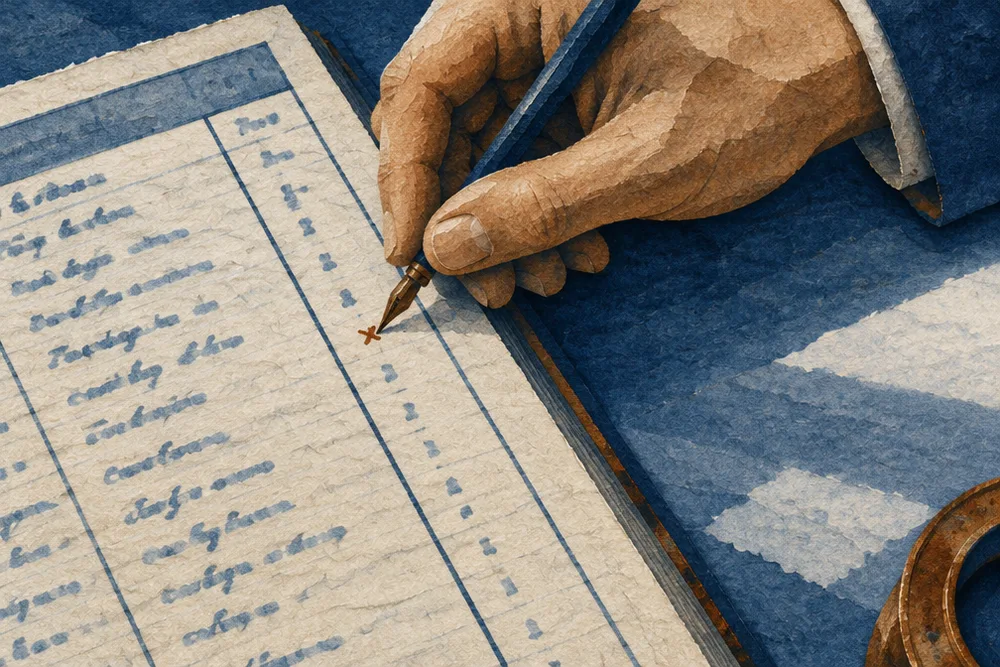
Nell stayed still. In earlier rehearsals she had sat at the head of a bench and fed Bess questions. Mara had stopped her when she answered for someone else. Now Nell stood below the gallery with no paper in her hand, listening while the words became Bess’s evidence, not Nell’s example. The clerk wrote the three boat names in the margin. The ruled page had no place ready for a worker, but the margin did.
Renn asked whether Bess could confirm the dates from her own records. “I kept no book,” she said. “I kept track of my work.” He asked if the dates might be mistaken. “A day, perhaps. Not which boat I worked on.” She did not claim more certainty than she had. Nell saw the clerk add a small mark beside the names, indicating that dates were approximate. The men in the front row could argue over the margin later; they could no longer say it had been empty.