Where the Last Ferry Waits
Page 204 of 218
Chapters
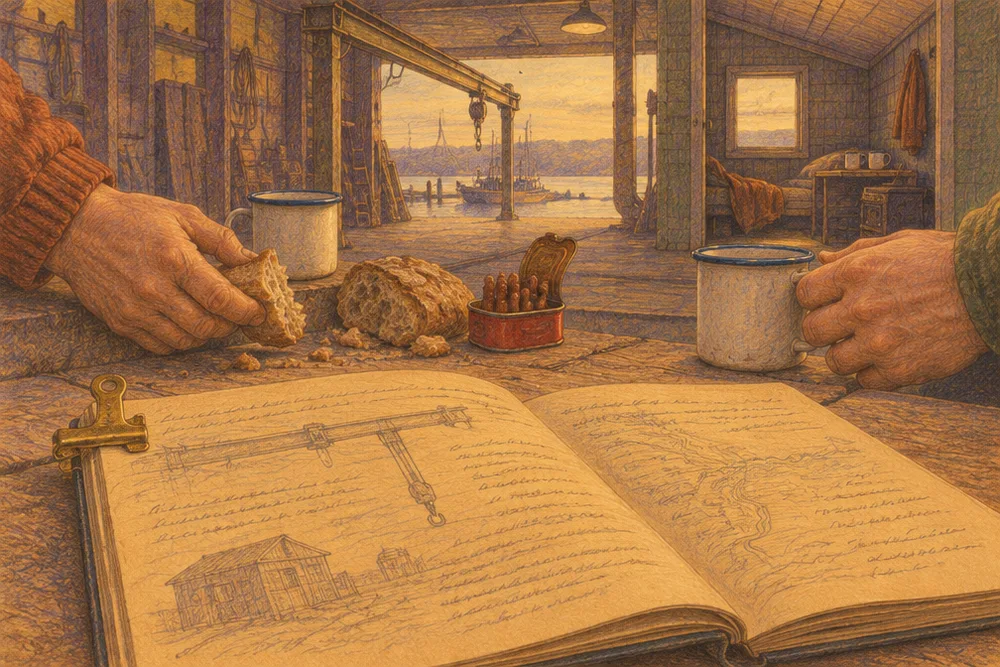
Mara opened the lid. The beans had stayed upright. The bread was slightly crushed where the tin had pressed against the jar, but the pieces were intact. She handed one to Pippa and kept the other. Their fingers touched at the paper wrapper. A brief, familiar spark passed through Mara, now held in the open air rather than the closed cabin.
Pippa took a bite. “Tess’s bread?”
“The heel. She said it was too short to sell.”
“It’s a good heel.”
“You say that about anything you don’t have to bake.”
“I once helped a bakery motor through a full shift.”
“You helped the mixer. You did not bake.”
“I helped the mixer remain a mixer.”
Mara laughed, and Pippa’s face eased. They ate for a minute without turning the silence into a test. Across the yard, a door shut. Somewhere beyond the buildings, a van started and drove off. Work was ending around them, in uneven pieces.
Pippa wiped a thumb over the edge of her bread. “I want the bay to work. I don’t want to want it so much that I tell myself the bad parts are fine.”
“Then we’ll come back to the bad parts.” Mara folded the wrapper closed. “You can count the inches. You can count the rent. You can count how many jobs fit on that bench.”
“And the parts I can’t count?”
“You can ask Len. You can ask yourself. You can ask me, if you want my opinion.”
“I do.”
Mara’s answer came before she could soften it. “Then I’ll give it.”
Pippa turned toward her. The yard light caught the silver at her temple. “I want your opinion because I trust how you look at things. Not because I expect you to fix the space for me.”
“Good.” Mara felt her shoulders loosen. “I have enough work fixing my own schedule.”
“How is the schedule?” Pippa asked.
Mara considered the answer. Her guaranteed four mornings at Pinchbeck had made rent possible. The temporary closing shift still pulled her day long, and the first week of production had nearly gone sideways when the ovens were slow and the wholesale pickup sequence assumed everything would be ready at once. She had negotiated the handover instead of trying to outrun the delay. The work was hers to manage, even when it went wrong.
“Better than before. Not easy.”
“The ovens still timing themselves badly?”
“The ovens are consistent. It’s the people who keep expecting them to do two things at once.”
“A familiar fault.”
“Tess says you should stop comparing machinery to people.”