Where the Last Ferry Waits
Chapter 1 · Two Mugs on the Radiator
Page 1 of 218
Chapters
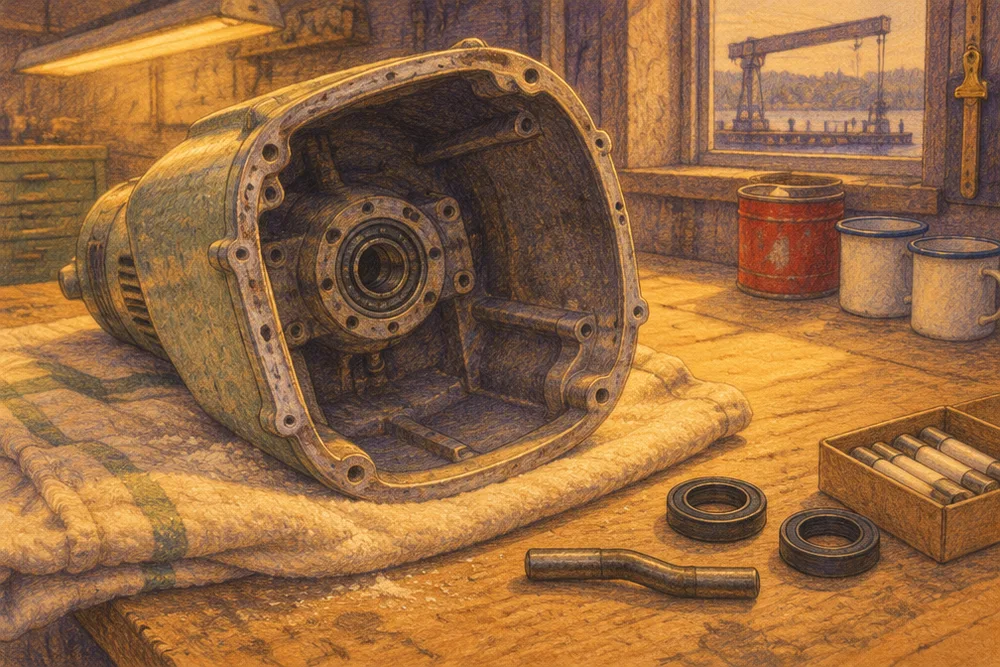
The mixer sat on a folded flour sack on Pippa’s borrowed bench, its casing open like a little tin mouth. She had spent the last hour coaxing the drive pin out without damaging the housing. The pin was bent; the replacement she needed was still on the ferry, wrapped in grease paper beside two pump seals and a box of fuses. The bench belonged to Hales Marine, and Hales had already asked twice when she would clear it. Pippa wiped her hands on her violet coveralls. Her brass pencil clip caught the strip light when she bent over the parts tray.
Mrs. Vale waited by the workshop door, holding her receipt between both hands. “You said it might be ready today.” “I said I’d see what the pin looked like.” Pippa kept her voice even. The woman had brought the mixer in from the island and paid the inspection fee. “It’s bent enough that I can’t safely straighten it, and I don’t have the right replacement here.” “Can’t you take one off the ferry?” “Not without putting a working machine out of service.” Mrs. Vale’s mouth tightened. “It’s my daughter’s wedding cake.” Pippa felt the weight of that, and of the two days she had already borrowed from the ferry’s maintenance shift to work on private jobs. “I can have the part brought over on the morning boat. If it matches, I’ll finish it then. I won’t charge you for another inspection.”
Mrs. Vale folded the receipt once, then again. “I’ll have to find someone else.” “I understand.” Pippa wanted to say she could make the part appear if she tried harder. She knew better than to promise what she could not do. Instead, she packed the loose screws into a labeled envelope and set it inside the mixer. “Nothing’s missing. I’ll keep it covered until you collect it.” The woman studied her face as if checking for reluctance, then nodded. “You’ve always been straight with me, Pippa.” She carried the mixer away, the flour sack dragging behind it. Pippa watched until the door shut.
The bench looked larger without the machine on it, but not more hers. A vice, a drill press, a rack of borrowed clamps: every useful thing had someone else’s name on it, or a place it had to be returned to. She had maintained the ferry for eleven years, had learned its motors by sound and its peculiarities by the feel of a wrench in her hand. People called her when a pump shuddered or a door jammed. Yet she could not promise a customer a clear bench tomorrow.