Where the Last Ferry Waits
Chapter 14 · The Motor That Fits in a Basket
Page 160 of 218
Chapters
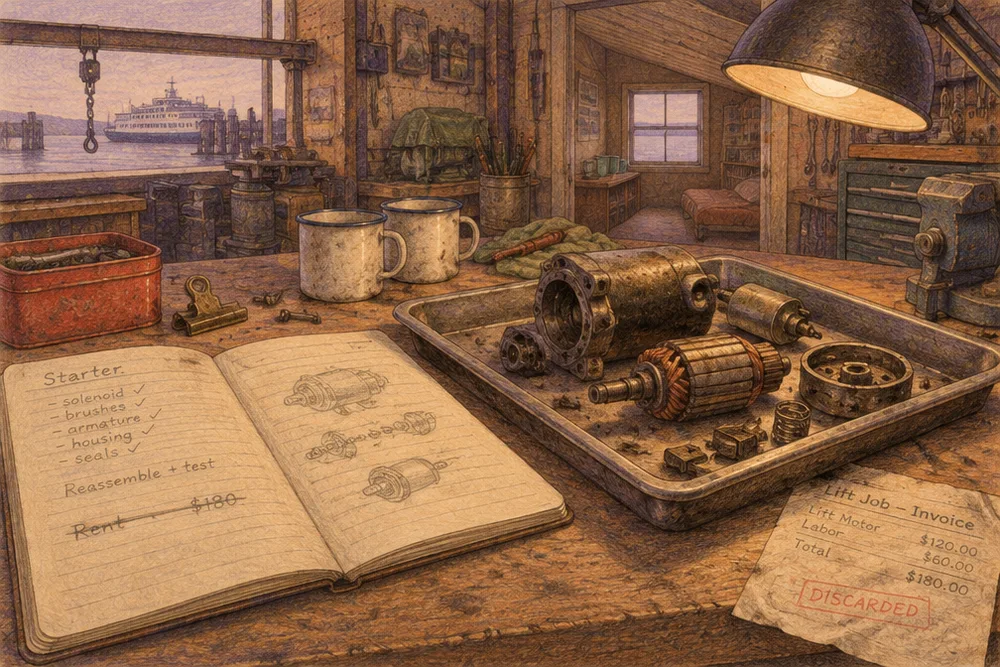
The first thing Pippa did with the shed money was cross it out. Not the whole amount; just the rent line in the notebook where she had written it as if the company’s offer were already hers. She drew one clean stroke through the number and left the rest of the page untouched. The hoist, the side door, the power supply—all of it had been real. So was the condition attached to the key. She had returned it. Now the page held only what she could carry without it.
At the ferry company’s maintenance bench, she took apart a small outboard starter and set its pieces in a shallow tray. The bench belonged to the crew, and the ferry’s own jobs had first claim. Her personal work had been squeezed into corners: a mixer motor under the vise, a pump wrapped in canvas against the wall. A customer could wait a day or two, but not forever. If she wanted her own work to pay for its own space, she needed to know what kinds of jobs that space could hold.
Her phone buzzed against the tray. The message from Orrel Marine Supply was short: a customer had an engine hoist job, big enough to make the week’s sums look different. Pippa called back before the phone stopped vibrating. The supplier’s voice came bright through the speaker, listing the engine, the deadline, the lifting gear available at the customer’s yard. Pippa listened with a pencil between her fingers and looked at the starter’s small, blackened spring.
“You’d be there to supervise the lift,” the supplier said. “They’ve got the crane booked. It’s good money.”
“And if the crane’s late?” Pippa asked.
“You bill the wait.”
She wrote the number on the back of a parts invoice. It was enough to make the crossed-out shed rent seem less like a mistake and more like a missed chance. She looked at it until the urge to say yes began to feel sensible. Then she asked how the engine would get from its stand to the worktable, whether the lifting point had been inspected, and who would be responsible if the customer’s gear failed.
The supplier admitted that nobody had checked the lifting point. The customer expected Pippa to bring her own slings and make the arrangement work. She could hire a hoist, but the hire charge and transport would eat into the fee, and she would still be taking responsibility for a job that depended on equipment she did not control.
“It’s not a bad job,” the supplier said, as if she had mistaken caution for insult.
“No,” Pippa said. “It’s just not mine to take on.”