Where the Flood Left Ink
Page 97 of 262
Chapters
She went back to Clegg before the office closed. He had kept the review schedule on the counter and was fastening his document case. Winifred told him she had asked the mill to confirm the transfers from its own account. She was precise: she had not seen the daybook; the office had not yet answered; Ned had said only that the book named the transfer parties.
Clegg stopped fastening the case. “You understand that a request is not corroboration.”
“Yes.”
“And the shift tally is not a parish receipt.”
“Yes.” She set her notebook beside his schedule. “But it may let the mill identify which entries to confirm. The dates and weights correspond to the receipts.”
He turned the notebook toward himself without touching it. “You have kept the different claims separate.”
“They are different claims.”
For a moment, Clegg’s long fingers rested on the case clasp. “If the mill supplies an extract, I will consider it. I cannot tell you whether that will settle the tenants’ individual shares. It may establish that the parish received a credit without establishing which household paid what.”
“Then we can leave the shares open until they are witnessed.”
“If you can.” He closed the case. “There is no advantage to me in sending an account back with gaps concealed. There is also no advantage in pretending a gap is a credit.”
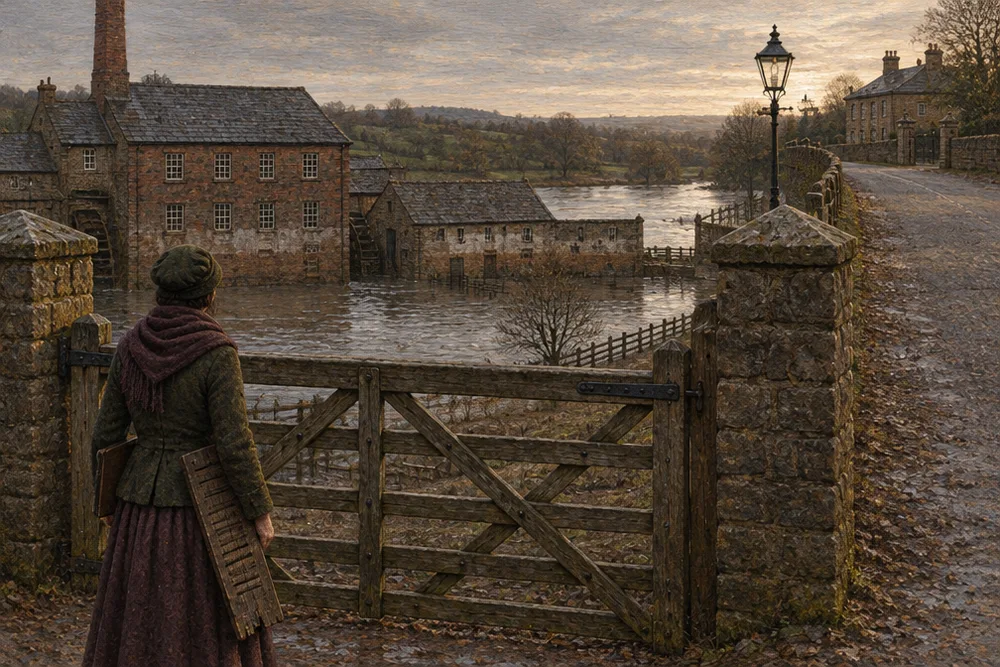
He left her with no promise and no dismissal. Winifred gathered her notebook and board. Outside, the river’s lower water moved between the banks in a dull pewter strip. The Fold lay beyond the mill, its back walls stained with the flood line. The higher road to the estate office was dry.
A woman from Alder Fold stopped Winifred near the gate. She had come to ask whether a receipt from her mother’s tenancy would still count now that another family lived at the door. Winifred explained that she had not yet matched it to a transfer. The woman frowned, then asked if the old tenant could come to the hearing. “If she will,” Winifred said. “And if the receipt belongs to her payment.”
The woman nodded and continued toward the low houses. Winifred watched her go, then looked back at the mill office hatch. The tenants had proof of what they surrendered. The mill alone could say where it entered the coal. Whether it would speak, and whether it would do so without putting a worker in the way, remained unsettled.