Where the Flood Left Ink
Page 34 of 262
Chapters
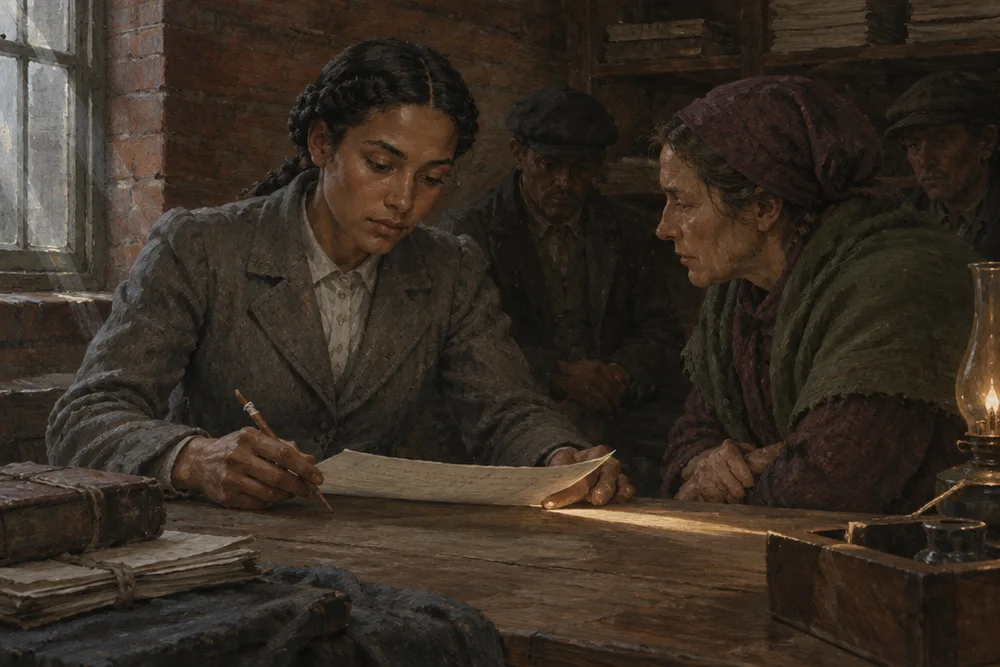
“You’re right,” Winifred said. “I’ll read each entry aloud before I call it a credit. If it belongs to more than one household, I’ll show each household what I’ve written. If anyone objects, I’ll leave the matter open.”
“And you’ll keep the original untouched?” Martha asked.
“Yes.”
Ursula rested one hand on the roll’s edge. “The old entries are not to be scraped away.”
“I won’t scrape them.” Winifred turned to Martha. “But I won’t copy a charge as settled just because it’s already there.”
The woman by the bench came forward, bringing her receipt. “Read mine first, then,” she said. “It may be the same day.”
Winifred invited her to sit at the table. She asked the woman to state her name, door number, and the date she had held the tenancy. Then she read the receipt’s words and the line on the fair sheet. The woman corrected one digit in the number, explaining that the faded mark was a seven, not a one. Winifred checked the mark against the paper and changed it, leaving the first reading visible beneath a single stroke.
The man who had paid into the batch took the chair next. He named his contribution but would not say whether he had handed the money to Martha or to another carrier. Winifred recorded the limit of his knowledge as carefully as the knowledge itself. Nobody smiled at that; nobody asked her to erase it.
Martha watched the pencil move. “That’s how it should be,” she said. “Not because I say so. Because each person can answer for their own part.”
The next tenant’s receipt showed a payment in coal, but its door number belonged to a household that had moved out before the flood. Winifred stopped before matching it to the name currently on the roll. She asked who had occupied the room then, and whether anyone knew where that family had gone. Two people offered different answers. She wrote both possibilities in the margin and left the credit unassigned.
Outside, more tenants arrived. Their shoes brought dried silt onto the boards. The bindery’s single useful light had shifted from the center of the table toward its far edge, narrowing across the paper. Winifred moved the fair sheet to keep the writing visible and did not hurry the next name.
By midday the queue had reached the stair. Ursula carried a chair from the upstairs room and set it against the wall, then returned to the table without comment. The shared household could not afford to turn away work. Neither could it afford to have a parish official decide that the account was too confused to trust. Winifred knew both facts; neither told her what to write.