Where the Flood Left Ink
Page 163 of 262
Chapters
Martha opened the tin. Receipts lay inside in folded pairs, their edges darkened by handling. She took one out and held it by the corners. “This is for coal delivered at the mill against rent. I carried the basket from the weighing place because I was going toward the Fold. It wasn’t all mine.”
“Who else’s?” asked Clegg.
“I can say who gave me their share. I cannot say what every household owed before that.”
“Were you paid to carry it?”
“No.”
“Did you deliver it all?”
“Yes, that day. I carried it to the Fold.”
“To which door?” asked one trustee.
Martha paused. She looked at the receipt, then at Winifred. “The number on the paper is the number it was entered under. The door there has had more than one family in it since. That is why I won’t tell you a name from the number.”
Winifred wrote the answer in full. She did not reduce it to “delivered” beside a sum. “Who can identify the shares?”
Martha turned toward the benches. A tenant on the aisle raised one hand, then lowered it as if unsure whether that counted. Martha waited. “If you know your own share, you can say it. Don’t tell me someone else’s unless they’ve asked you to.”
A second woman spoke from her seat. “I gave you the small sack. My boy was at the mill with you.”
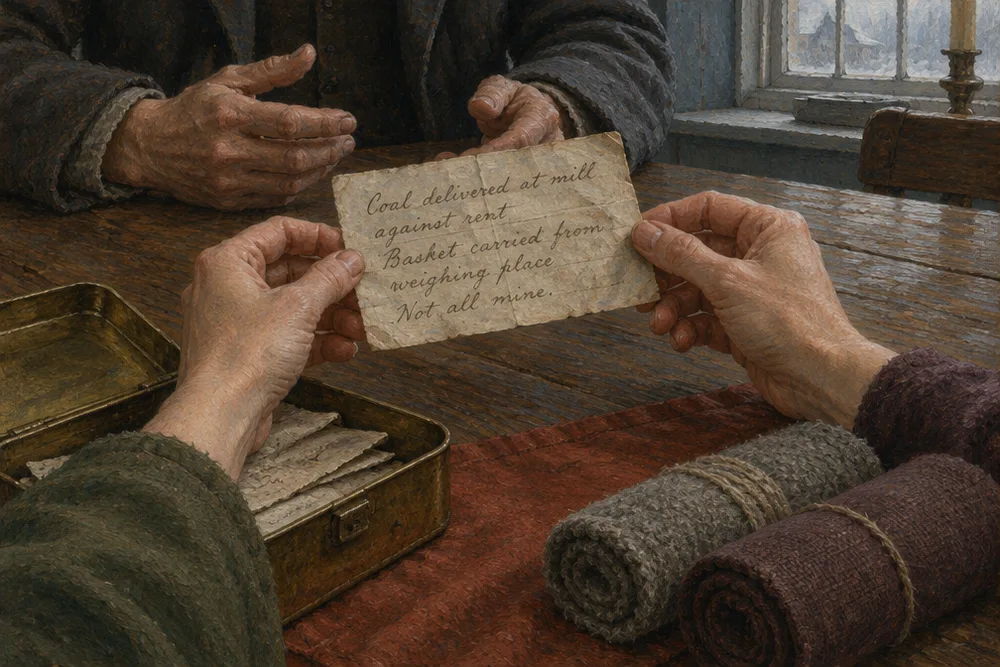
“You did,” Martha said. “I remember the boy. I won’t put a sum to it until you tell me what you paid.”
The woman leaned forward, eyes fixed on the paper. “Write that I gave it.”
Winifred wrote the words, then repeated them aloud. “You gave a share to Martha for this batch. The amount is not yet confirmed.”
“That’s right.”
“Do you have the mill’s tally?” Clegg asked.
Winifred drew out the copy of the batch extract. The original had remained with the mill office, but the extract named the delivery and the parish credit. Its figures agreed with the amount on Martha’s receipt. She placed it beside the receipt without covering either.
“This confirms a batch went out and the mill credited the parish,” she said. “It does not divide the batch among the households.”
“The tenants’ shares would add up to the total,” Clegg said. “If they are all proved.”
“If,” Martha replied. “And if you don’t charge the same coal as rent paid and then turn around and charge the full rent again.”
Clegg’s fingers tapped once on the table. “No one intends to charge twice.”
“The book already does.”