Where the Flood Left Ink
Page 151 of 262
Chapters
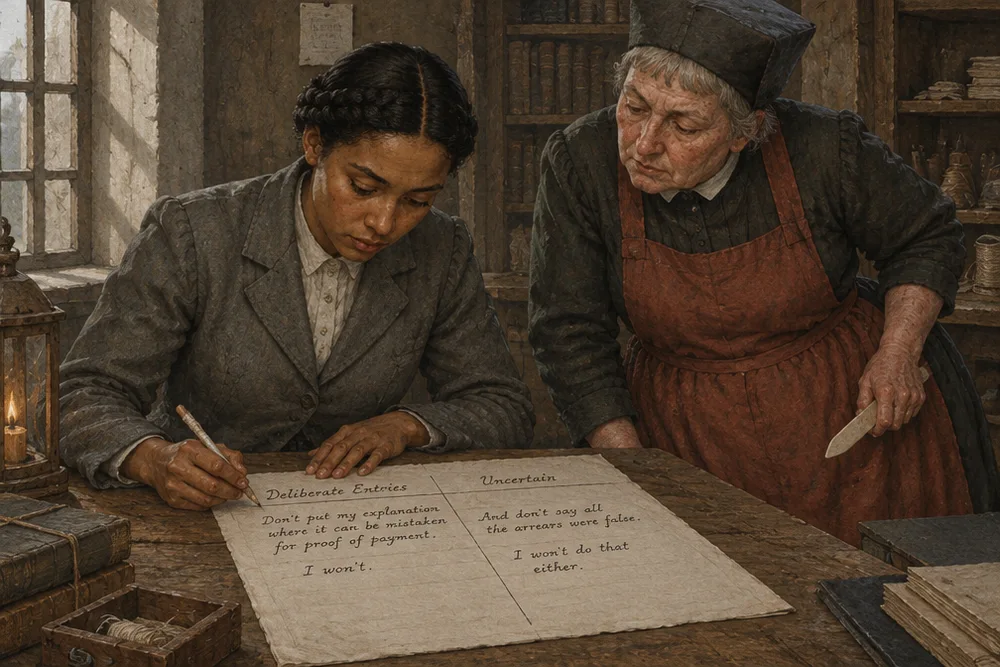
“There are other entries I cannot swear to,” I said. “Not the coal marks. Those I made knowingly. I meant the arrears list to keep the households in view for winter fuel. But there are cash balances, and dates. Some I remember as paid; some I only remember intending to check. I cannot let them all pass under the same heading.” “Then we need the difference written down,” Winifred said.
She fetched a sheet and ruled two columns with the edge of her ruler. One heading was deliberate entries. The other was uncertain. I looked at the words. “Don’t put my explanation where it can be mistaken for proof of payment.” “I won’t.” “And don’t say all the arrears were false.” “I won’t do that either.” Her answer was as exact as a stitch pulled tight, though she left the thread visible.
We worked through the entries I could still recognize. For the coal payments, I explained the pinprick I had used to mark a settled delivery for my own reference, while leaving the amount in the arrears column for the subscribers’ list. I named which households I remembered and which marks I could not tie to a particular delivery. Winifred wrote each statement separately, asking me to stop when I moved from memory into guesswork. More than once I stopped. That was harder than I expected.
The water had blurred some sums, but not all the uncertainty belonged to the water. I had written one name over another after a change of tenancy. I could remember a disagreement over a few pence and not whether the tenant had paid them. I could recall turning someone away. My recollection did not prove the account either way. Winifred made a note of the date and door, not a judgment.
“You’ll have to sign this,” she said when the statements were arranged. “Not because you’re sure about every figure. Because you’re sure about what you did, and because you don’t know the rest.” I looked at the page. A signature could be used against me. It could also be used to claim I had cleared debts I could not clear. “Write that it is not a receipt.” Winifred added the words. “And not a settlement.” She wrote those too.
When I reached the last page, I asked for the statement to say plainly that I had kept some households on the coal list by entering their rent payments as arrears. I did not want the phrase hidden beneath an account heading. “That was the reason,” I said. “It was not the same for everyone.” “Then we’ll say it was the reason for those marks you identify.” Winifred put the limit into the sentence. “And the tenants’ receipts and the mill records must still be checked.”