What the Water Left Blank
Page 67 of 158
Chapters
The discipline between them held. She was grateful for that, though it made her wish she could simply ask him whether he thought the memory was true. He rolled his shoulders once, easing stiffness from the walk. There was a faint line beside his nose where his glasses had pressed; she had not noticed it over breakfast.
“You could have told me you were going to ask about the hatch,” she said.
“I didn’t know it was there to ask about.”
She smiled. “Good answer.”
“It wasn’t an answer.”
They waited until Tamsin came to the workroom. She carried the registration weights and set them down at the bridge and stair marks, checking both against the bench before she let either of them touch the papers. Merrin watched her straighten the sleeves, then watched Levan keep his hands flat on the table instead of reaching for the tracing first.
“The accounts are sealed,” Tamsin said. “We’ll open them together. One layer at a time.”
Merrin’s mouth had gone dry. “Understood.”
Tamsin opened hers. The sheet showed the street front in careful lines, with a small recessed shape marked low on the wall. Beside it were the words Tamsin had used: ledge, narrow opening, remembered hands. The drawing was not as exact as Merrin’s, but its proportions held. The hatch sat just west of the center of No. 4’s frontage.
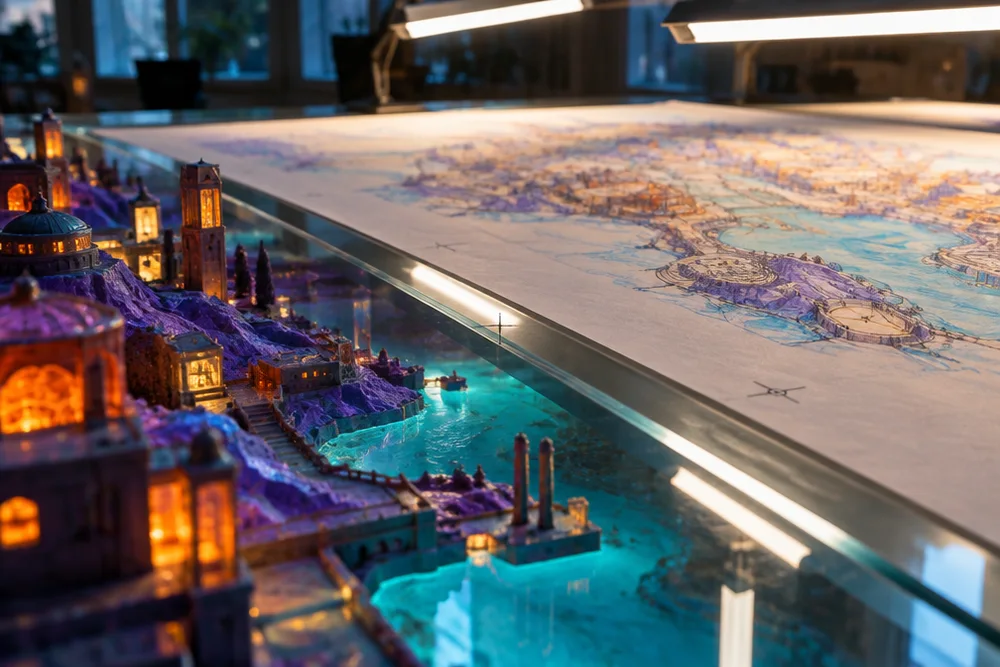
They set the sheet over the model’s clear registration field. Levan aligned the bridge and stair marks without touching the drawn detail. Merrin pressed one weight down. Tamsin fitted the second. The paper settled flat.
Levan opened his tracing. Ivo’s sheet showed the approach to the former shop from across the street, not the hatch itself. It recorded a low interruption in the frontage and a place where people paused. His notes described collecting paid orders and waiting for the hatch to open. The drawing placed the interruption in the same portion of the wall as Tamsin’s mark.
Merrin leaned over the table. The two lines met. Not perfectly—the street had changed, and Ivo’s recollection was of a different purpose—but the register was plain. The hatch occupied a real, repeatable place. Her mother’s shop had not only sold bread through its front door. Some customers had waited at a small opening in the wall.
Tamsin studied the overlay, then the two sealed labels. “The hatch is corroborated. Ivo’s paid collection is his account, and we can attribute that beside the location. We don’t have corroboration for the awning.”