What the Water Left Blank
Chapter 4 · Shared Steps at Dusk
Page 32 of 158
Chapters
Merrin Prowse had the kind of doubt that made a person point at a thing while asking whether it was there. Her finger hovered above the tracing, just shy of the pencil line that ran from the bridge mark to the stair mark. “You’ve shifted it.”
Levan Nairn set down his brush. Under the work lamp, the tracing paper shone thin and greasy, the bridge and stair registration marks showing through from the sheet beneath. Beyond the glass, Bellwick’s streets stopped where the model’s bare board began. “I haven’t.”
“The lane doesn’t meet the steps at that angle.”
“It does on both accounts.”
“Neither account has a scale.”
He looked at her. Her square face was turned toward the model, black curls tucked behind one ear and springing loose at the other. The chipped edge of her incisor showed when she pressed her mouth into a line. Flour dust still whitened the cuffs of her plum jacket, though the bakery that had put it there was long shut. She had watched him register the sheets yesterday, and again this morning. Now she watched as if he might confess to a trick if she stared long enough.
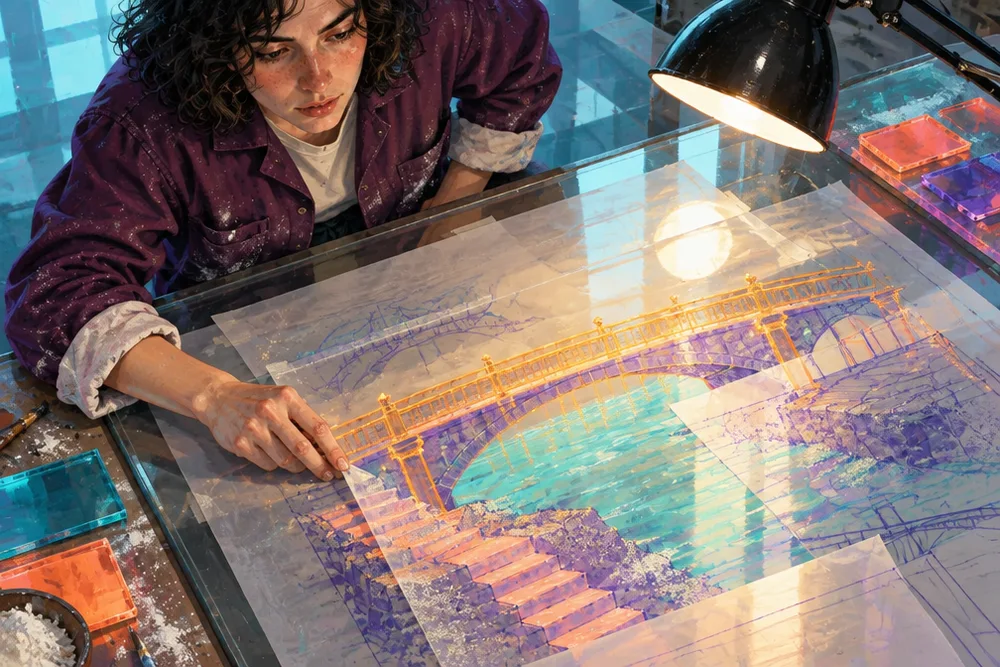
“Then let’s check,” he said.
For a moment she didn’t move. The question had been sharp; the offer made it harder to keep it that way. She stepped back from the table and gathered the steel rule, the calipers, and his small brass square in both hands. “You check. I’ll read.”
Levan had learned that a clean sign could still lie. A letter might be beautifully balanced and still point to the wrong door. His work was to make claims legible, not to make them true. At the museum, Tamsin Vale had made the distinction plain: only details remembered independently could go on the physical model. The rest could have a place beside it, with the name of whoever remembered. Nobody got to turn a strong feeling into a measurement.
He had assumed, when the museum hired him, that the job meant lettering a few stubborn gaps. Instead, he had spent two days figuring out how to show uncertainty without making it look like a mistake.
He laid the brass square against the painted stone edge of the old bridge, careful not to press on the acrylic. The model was waist-high beneath its protective glass, though the glass had been lifted for the day’s work. Dry stipple picked out the bridge masonry in violet shale; tiny neon roofs rose from the board like a town remembered in the colors of a fairground. Beyond the last marked street, the model remained bare.
“Zero here,” he said.