What the Water Left Blank
Chapter 2 · Marks Beneath the Lamp
Page 11 of 158
Chapters
The fee was written in three places: on the museum’s contract, in Levan Nairn’s notebook, and on the back of the envelope holding his bus ticket home. Lettering, registration, two rounds of corrections. No reconstruction. No guarantee of what the model would say once people began remembering aloud. He had underlined that last part before signing, though it had not been in the contract. A painter could make a blank look deliberate. He could not make it true.
The museum stood above the flood line, a gray stone building with its windows turned toward the valley. Inside, the Bellwick model occupied a waist-high table beneath glass. It showed the bridge, the mill, the river bends, and a seam of streets that stopped abruptly west of the bridge. The blank patch was the color of bare board. Someone had dusted it carefully; there was not a fingerprint in the emptiness.
Levan set down his case of brushes and the small tin of ochre paint he used for lettering. Under the lid, the model’s reflections broke into bright bars. He shifted sideways until the glare slid off the glass. The bridge remained clear; the street beyond it did not appear by wishing.
“You’re early,” Tamsin Vale said. Her blond braid lay straight down the back of a charcoal waistcoat, its piping a sharp lime line. She held a stack of paper accounts against her ribs. “Good. We have a witness meeting at ten.”
“I’m here to letter what’s established,” Levan said. “I thought the meeting was to establish what’s established.”
“It is.” Tamsin looked toward the adjoining room, where chairs scraped and voices had already started. “The distinction has been eluding us.”
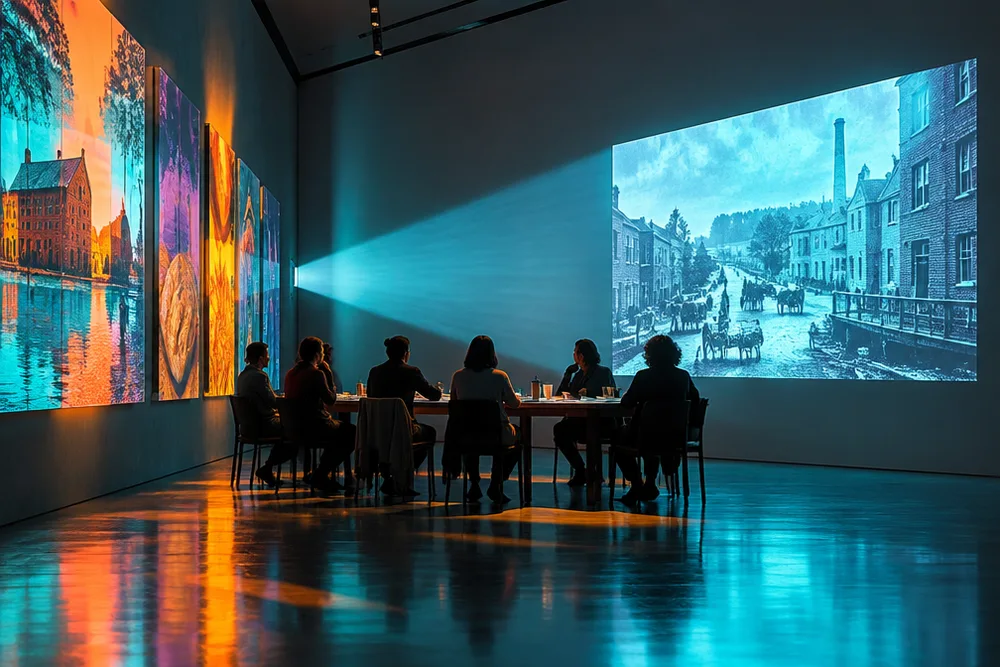
The room had no windows, only a fluorescent strip that made every face look a little tired. Six residents sat around a table, each with a paper cup and a view of a photograph projected on the wall. The picture showed a street of low shopfronts, distant enough that the doors were dark squares. Someone had written MILL STREET across the bottom in blue marker.
“That was the Prowse bakery,” a man said. “I remember the red awning.”
“It was striped,” said a woman beside him. “Coral and cream.”
“No awning at all when I was small,” another voice answered. “Just a sign.”
The first man leaned forward. “It was certainly there by the time I was small.”
Levan watched the room accept the shape of a shared memory. Heads nodded, not because the accounts matched but because the disagreement had acquired a pleasant familiarity. A woman who had not spoken yet began to say, “I think it faced the bridge,” then glanced around and changed it to, “We all knew it faced the bridge.”