What the Water Left Blank
Page 56 of 158
Chapters
“Understood,” Merrin said.
“The first date should be the shop period, not the first time anyone remembers seeing a sign.” Tamsin tapped her pencil against the empty box. “We’ll need the best-supported span, and we’ll say when the evidence is uncertain.”
Levan placed his amended text beside her hand. “This version distinguishes the address from the account. I’ve left the account attributed.”
Tamsin read it silently. “Better. It doesn’t suggest that Nessa gave up her kitchen to Ada, or that Ada moved the whole shop there.”
“She charged rent,” Merrin said. “That’s what the ledger gives us.”
“Then that is what we can say. Nessa can add her own words to the adjacent panel if she wants them.” Tamsin looked at Merrin. “She isn’t an instrument we use to complete your mother’s story.”
“I know.” Merrin’s answer came without delay, though she lowered her gaze a moment later. “I’ll ask her what she wants recorded.”
Tamsin gathered the forms. “Good. We start the separate walks at nine. Levan, I need you to register the scale sheets. Merrin, you’ll have a different witness group. No one compares notes until we’re back.”
“And the overlay at dusk,” Levan said.
“If the weather holds.” Tamsin tucked a loose strand of blond braid behind one ear. “If it doesn’t, the work waits. We don’t get a better answer by rushing.”
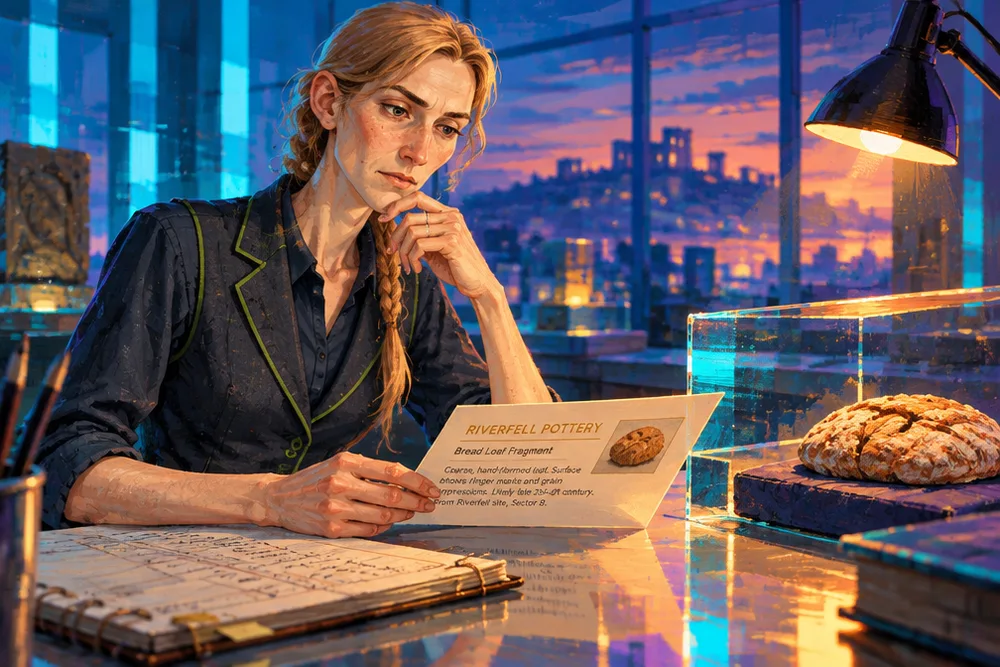
Merrin watched her go, then turned toward Levan. Outside the upper windows, evening had taken the sharpness from the rooftops. A thin band of cloud held a copper color over the valley, while the museum lights began to show in the glass.
“I should get something to eat,” she said. “I forgot lunch.”
“There’s a café near the bus stop.”
“It’ll be closed by now.” She checked the time and frowned. “I have bread in my room, I think.”
“Bread is a sound plan,” Levan said. “Provided you like bread without anything on it.”
“I can find something.”
“That sounds less convincing.”
She was already putting her jacket back on. The cuffs were pale with flour, though the rest of her clothes had stayed remarkably clean. He had noticed the cuffs before: the residue of her own work, a small bit of the life she’d carried up from the valley. “Do you want to come?” she asked, then paused. “Not to inspect my food. Just—if you haven’t eaten either.”
He heard the offer and the quick retreat built into it. A practical invitation, safe to accept and easy to deny having meant anything by. He recognized the form because he had used it himself.