What the Water Left Blank
Page 47 of 158
Chapters
Merrin wrote the words as Nessa said them, then turned the notebook so she could read them. Nessa leaned in, checked each line, and nodded once. Merrin was relieved by the approval, then embarrassed by how much she wanted it.
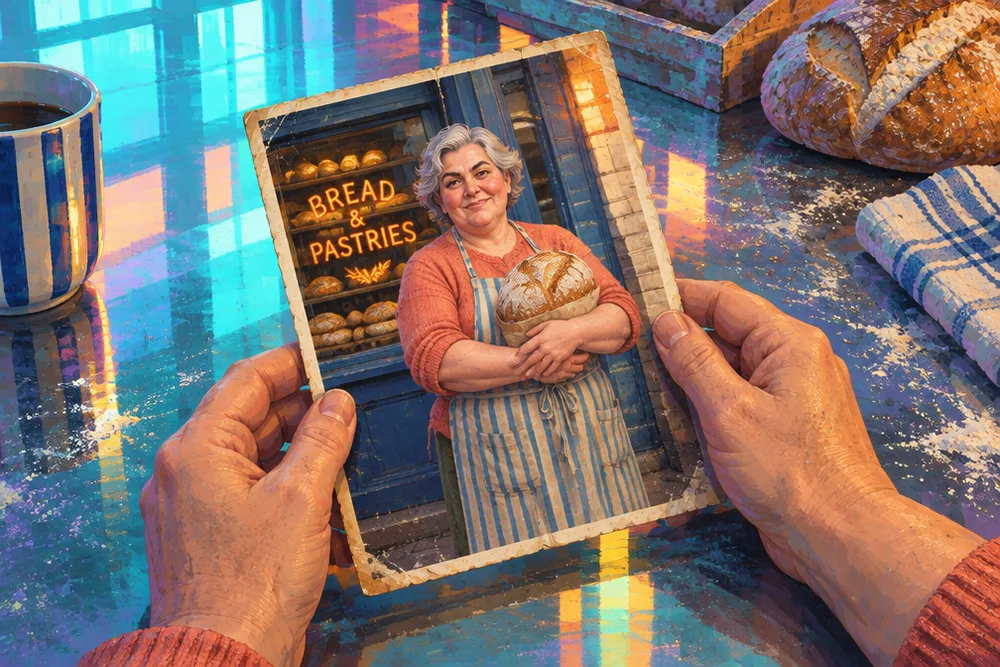
“There’s a photograph,” Merrin said. “From the shop. My mother’s wearing the striped apron.”
“I remember it.”
“It might help date the storefront.”
“It might date her apron.” Nessa reached for the scone tin and pushed it closer. “Don’t make one picture do the work of a survey.”
The photograph was in Merrin’s coat pocket, folded inside a paper sleeve. She had brought it to the museum the first day and Tamsin had declined to place it on the model without independent corroboration. Merrin had thought that was an unnecessary severity. Now the refusal seemed less like a wall and more like a question asked carefully.
She slid the print out. Ada stood in front of the shop door, short silver hair bright against the shadowed lintel, her striped apron over a coral sweater. Her thick forearms rested on her hips; her smile had the incisive edge Merrin remembered from every photograph and, less comfortably, from life. Behind her, the shop sign read ADA PROWSE in painted capitals. A corner of the display window was visible, and the edge of the street.
Nessa studied it. “That was after the new sign.”
“You remember when it went up?”
“I remember the sign painter asking for tea. He got paint on my gate. But I can’t give you a year.”
Merrin took the photograph back. “It’s still useful.”
“It is. It tells you the sign existed. It doesn’t tell you the hatch was on the west side, or what number was over the door, or whether the doorway you remember is the doorway in this picture.” Nessa glanced at the tracing. “Your memory’s good. It just isn’t the only thing that counts.”
Merrin looked again. The picture held her mother, the shop, the bold name above the door. It held almost nothing of the street around them. She saw how much she had asked it to prove.
The image had been taken close enough to crop away the neighboring doors. Merrin could see a sliver of stonework at the left edge and a dark band of pavement beneath Ada’s shoes. There was no street number, no bridge, no stair, no angle of the roofline that would register against the model. The sign was proof of a name, not an address.
“I can use it as a dated object if we can date it,” she said.