What the Water Left Blank
Page 41 of 158
Chapters
“I ask who will be harmed if I leave it out. And who will be harmed if I put it in.”
She considered that. “That’s a hard way to work.”
“It keeps me busy.”
“Is that why you took this contract?”
He could have said the fee was fair, the timeline short, and the museum had a reputation for paying on time. Those things were true. They weren’t the whole answer. “I wanted a reason to be here for a while.”
“You’re not from Bellwick.”
“No.”
“Where are you from?”
“A few places.” He watched her waiting for more. “I never found one that asked me to stay. Or maybe I stopped waiting to be asked.”
Merrin’s expression shifted, not pity, not exactly. “That sounds familiar.”
“You’ve stayed away long enough?”
“Long enough to know the town doesn’t become yours again just because you walk back into it.”
Outside, a vehicle passed on the road. Its headlights swept the window, then disappeared. In the brief flare of light, the table’s old scratches shone silver. Merrin picked up the bread knife and began cutting another slice, though the loaf was already open between them.
“I called my mother every Sunday,” she said. “After the shop closed. I asked about the weather, the roof, the people who still lived here. She’d say she was busy with bread, and I’d tell myself she meant she missed the bakery. I never asked what she was doing.”
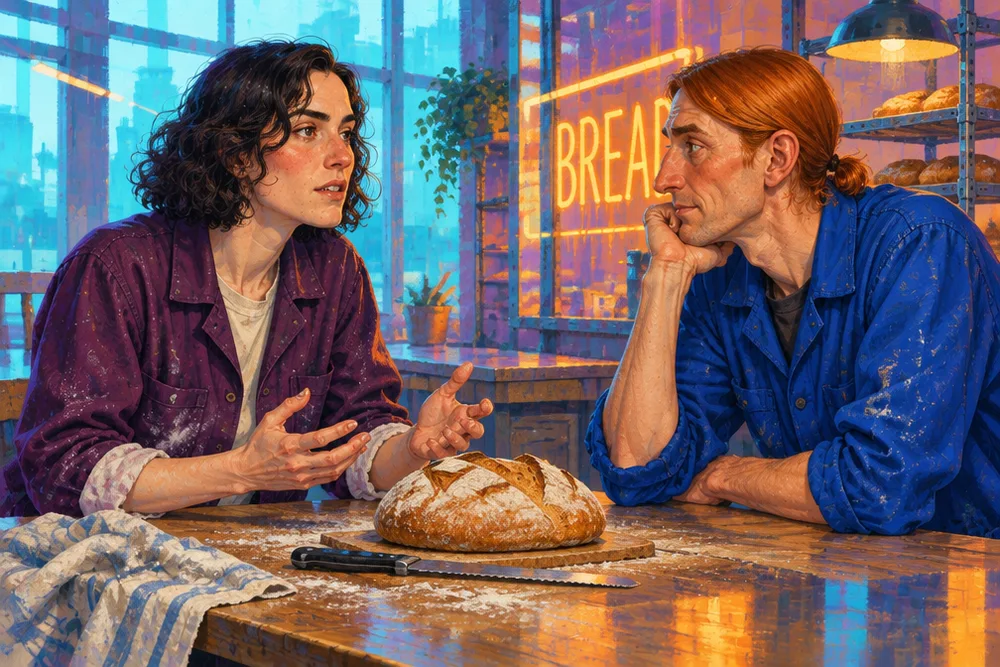
Levan stayed quiet. He knew the difference between a silence that invited and a silence that demanded. This one belonged to her.
“I didn’t know about the orders,” she said. “Not until I came back.”
“You’re finding out now.”
“Yes.” She set the knife down. “I don’t know if that makes it better.”
“It doesn’t have to make anything better,” Levan said. “It can just be true.”
Merrin’s mouth tightened, not in disagreement but in effort. “People say that when they want the truth to finish the conversation.”
“I don’t.”
“What do you want it to do?”
He thought of the sheet on the workbench, the raised marks resting beside the board. “Give us somewhere to start.”
She looked at him for a long moment. Then she reached for the saucepan and scraped the last of the soup into his bowl. “You’re good at that.”
“At starting?”
“At not trying to make a neat ending.”
“The exhibit needs an ending.”