What the Water Left Blank
Page 2 of 158
Chapters
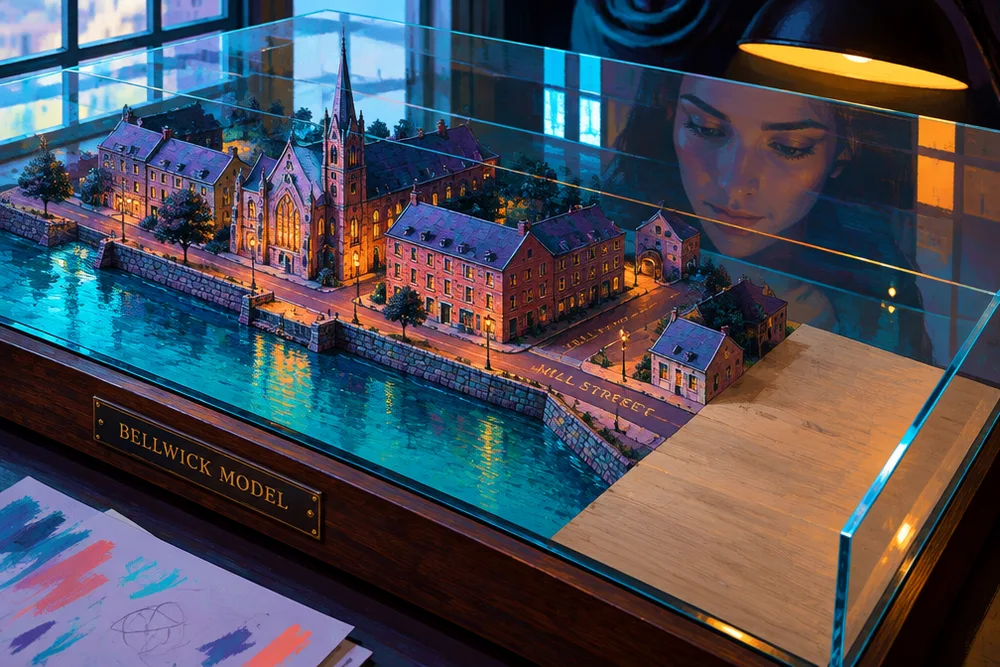
Merrin leaned over the glass. The town looked almost affectionate from above, each roof snugged against its neighbor. The bridge remained where she remembered it, as did the open square and the mill yard, marked by a cluster of dark chimneys. Mill Street ran west from the bridge, past a narrow lane, and stopped at a pale patch of bare board.
She looked for the bakery by habit: No. 4, the blue frontage, the square window where Ada used to set out loaves to cool. The model had no shop there. No. 4 was a clean blank, and so were the attached houses all the way to the bend. The lane was only a thin gray line. It seemed less like an omission than a sentence that had been cut off.
“Where is it?” Merrin asked.
“The model shows structures we can place with confidence,” Tamsin said. Her voice held no defensiveness, only the measured clarity of someone who had repeated a policy until it stopped sounding personal. “We have a complete survey for the eastern bank and fragments for the old quarter. The Mill Street survey was lost during the archive move.”
“But you have photographs.”
“Some. None that gives us a reliable position for every building.” Tamsin indicated a folder on the workbench. “Your mother’s photograph shows her in front of a bakery sign. It is useful evidence for the sign and the business. It doesn’t establish the exact address.”
Merrin straightened. “I grew up there.”
“I know.” Tamsin’s gaze softened, briefly. “Your memory matters. The museum’s rule is that a detail enters the model only when two residents remember it independently. We can display attributed testimony separately. But I can’t put a building on the map because a photograph or one witness says it belongs there.”
The glass reflected Merrin’s face over the blank street: square jaw, wide-set hazel eyes, curls already frizzing at the damp. She had expected a small correction, a place for a name. She had not expected the town to have been erased neatly enough to look deliberate.
Tamsin unlocked the case and lifted the cover with the care of a person handling a sleeping animal. “You can see the work surface,” she said. “We’re adding details before the opening. Not many. The bridge registration marks are fixed, and the stair from the church is fixed. Anything else needs to be supported.”
On the bench beside the model lay a sheet of tracing paper with a few pencil lines, a metal ruler, and a small brush with its bristles cut square. A man in cobalt coveralls stood at the far end, sorting narrow strips of painted lettering. His copper hair was clipped at the nape. When he turned, Merrin noticed his hooked nose and dark eyes, the steady weight of him resting back on his ochre boots.