What the Water Left Blank
Page 152 of 158
Chapters
Merrin stopped with the cards in her hand. The woman had not come to settle an argument. She was using the two addresses to make sense of a family habit that had passed to her as a half-remembered errand. Her eyes moved between the shopfront and the marked kitchen, then followed the narrow lane toward the shared steps. She seemed to be measuring the distance with an old familiarity she had not expected to find here.
The woman noticed Merrin watching and gave her an apologetic smile. “I’m sorry, I’m in the way.”
“You’re not,” Merrin said. “That’s what the labels are for.” She set down the cards at the desk and came back to stand beside them. The woman traced the route in the air, from the imagined corner of the shop to the shared steps behind No. 11.
“Grandma never mentioned the shop being closed,” the woman said. “She just said Mrs. Prowse had good crusts.”
The sentence landed softly, without ceremony. Merrin felt it find the place in her that had once insisted Ada’s work stopped when the storefront did. She pictured her mother’s hands pressing dough into a tin, flour caught in the creases at her knuckles; then the image altered, placed in a kitchen Merrin had once known only as a back door and a staircase. “She did have good crusts,” she said.
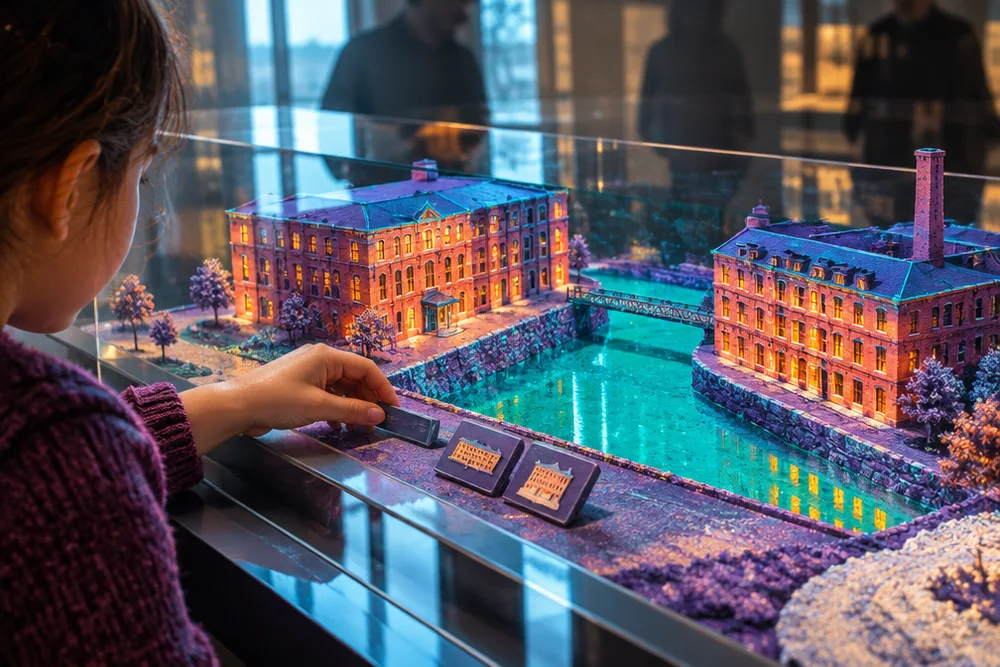
She did not add that she had failed to ask where they were made. The woman read both labels again, then wrote her grandmother’s name on a card for the drawer of unresolved memories. She did not write about an awning. She wrote that her grandmother had collected bread on Saturday mornings, carrying it home wrapped in a tea towel. Merrin watched her slide the card into the drawer, where no one had to decide whether one memory canceled another.
At the desk, Tamsin checked the order cards and asked whether the lease was signed. Her blond braid lay over the shoulder of her charcoal waistcoat, the lime piping sharp against its dark fabric. She turned the stack square with the desk edge before setting it in the display.
“Yes,” Merrin said. “For a year.”
Tamsin’s eyes warmed, though her voice stayed brisk. “Then you’ll need to keep the place busy.”
“That’s the intention.” Merrin glanced back toward the model. The bright water beneath Mill Street was still only paint and glass, but the paired addresses seemed less like a verdict now than a way through. Someone could arrive carrying an incomplete memory and leave with two places to ask about. That felt worth keeping in view.