What the Water Left Blank
Page 107 of 158
Chapters
For a moment neither of them moved. Sunlight crossed the model glass in a bright bar, then slid away as a cloud passed. Under it, the valley streets gleamed in fragments: the bridge, the stairs, the careful painted edges of buildings that had once held ordinary days.
Merrin opened her notebook to the new list. “I need to test the oven tomorrow. Ivo says the market meeting is Thursday.”
“I can come by after the museum opens,” Levan said. “If you want help with the sign.”
“We agreed a fee for the trial sign. I’ll bring the amount to you.”
“All right.” He reached for the brush again. The choice to let her decide the terms seemed to matter to him; she saw it in the ease of his shoulders, though she might have been imagining that. “I can also help you set the lettering if you want the sign to be readable from the yard.”
“I want it readable from the bus stop.”
“Then we’ll test it from there.”
Tamsin slid the mockup label into a folder. “You two can conduct your business without blocking the bridge registration marks.”
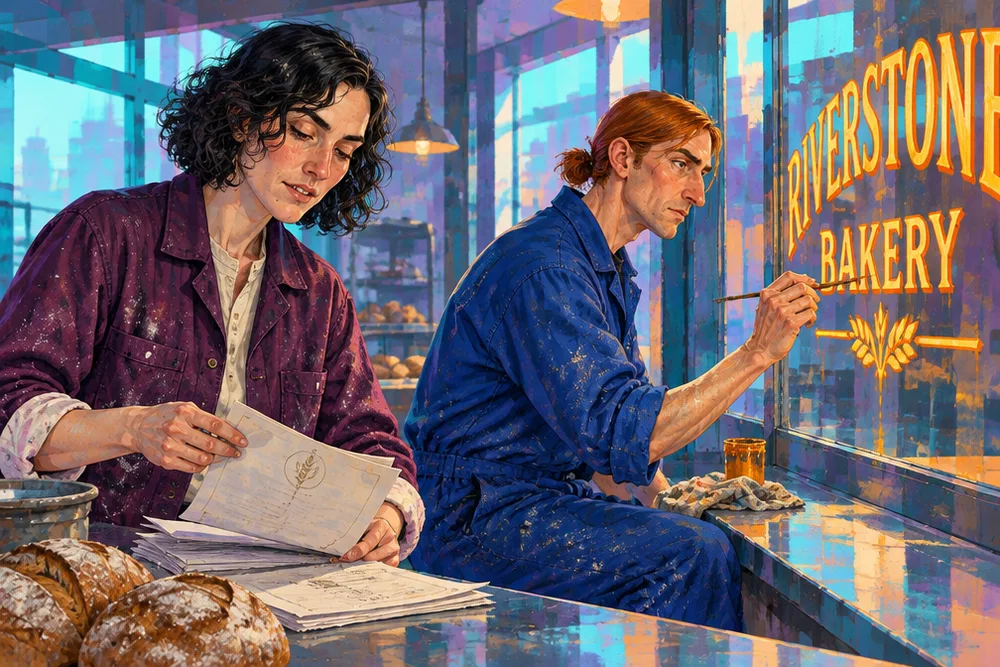
Merrin stepped back at once. “Sorry.”
“I’m teasing. Slightly.” Tamsin’s mouth made a thin, amused line. “The label is what we need to settle. Not the order book.”
The museum’s work was still there, waiting: two addresses, carefully dated; an account attributed to Nessa; a blank space where no one had proved the shape of an awning. Merrin felt the old pull to fix every uncertainty before she let herself leave it. But the model did not need her to be certain of everything. It needed her to distinguish what she knew from what she wanted to be true.
She closed her notebook. “I’ll be back after the oven test.”
Levan’s brush moved again, painting an even stroke of amber across the sign. “I’ll be here.”
It was not a promise to follow her uphill, or to wait for her, or to make a home out of the work. She heard only what he had said. She was beginning to understand how much depended on that distinction.
“Then I’ll see you tomorrow,” she said.
She took the order copy from beside the model and tucked it safely into her jacket. The paper was plain, the figures modest, the signatures real. Outside, the bus pulled up to the stop above the museum, ready to carry her toward the kitchen she had chosen to try.