What the Gauge Left Out
Page 212 of 259
Chapters
The witness had supplied a useful account, but Fenna would not make the case depend on a person who had chosen not to be exposed. She had seen how easily an omitted name became an omitted household. She wrote in her notebook that the anonymous observation was set aside for the survey, not withdrawn or disproved.
Siv watched her write. “That’s a distinction people forget when it suits them.”
“It stays in the record,” Fenna said. “It just doesn’t carry the measurement.”
The survey team continued along the lane, plotting the visible thresholds and the surviving wall line. The route did not need the anonymous point to make sense. It needed the relative heights, the inland slope, the opening in the terminal works, and the first sightings the named residents had agreed to place.
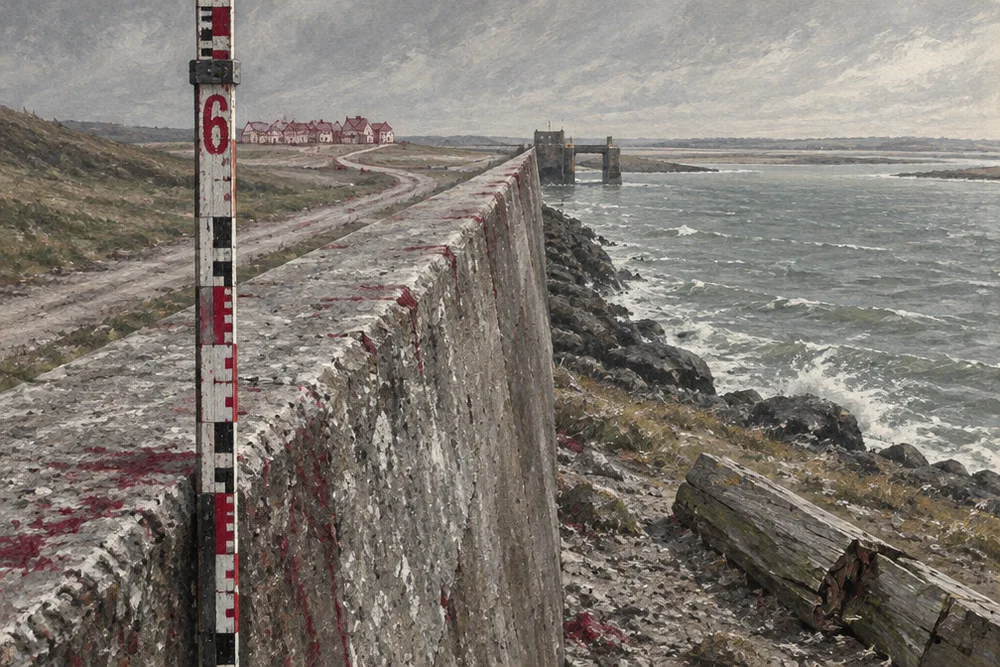
At the old street defense, the surveyor’s rod stood upright against a seam in the concrete. Mara checked the level once more and called out the crest elevation. Then she walked the team back toward the terminal approach and had the assistant place the rod at its low threshold.
The numbers matched the first run. They also matched the archived leveling sheets Fenna had submitted from the station file. The old independent gauge and the station post shared their datum; the current survey confirmed that the harbor wall crest was higher than the terminal entrance.
Mara turned to the panel clerk. “On topography alone, there’s no contradiction in a peak below the crest and water reaching the lane by the terminal approach. The path is lower and runs inland.”
The clerk asked, “Can you say water did reach the lane that way?”
“Not from elevations alone. That’s where the movement record and the witness sequence matter.”
Fenna felt the shape of the finding settle into place without becoming more certain than the evidence. A low harbor reading and deep flooding on Hem Lane could both be true. It was not a trick of numbers. It was a route the official account had left out.
The panel held the questioning in the Weight Room, the old fish-weighing hall. Its ramp ran up from the public door to the low evidence table, and the panel sat on the same floor as the witnesses. Fenna took a seat near the back. She could hear the crossing through the hall’s open high windows, the engines rising and fading as boats came and went.
Toll Marris sat at the table in his boxy slate vest, yellow pay envelope folded beneath his hands. He rocked back on his heels whenever the chair legs creaked. The panel chair asked him to describe the duty book entry and the carbon vehicle chit that placed an unscheduled arrival inside the eleven-minute gap.