What the Bell Owes
Chapter 9 · Two Boats on Paper
Page 84 of 210
Chapters
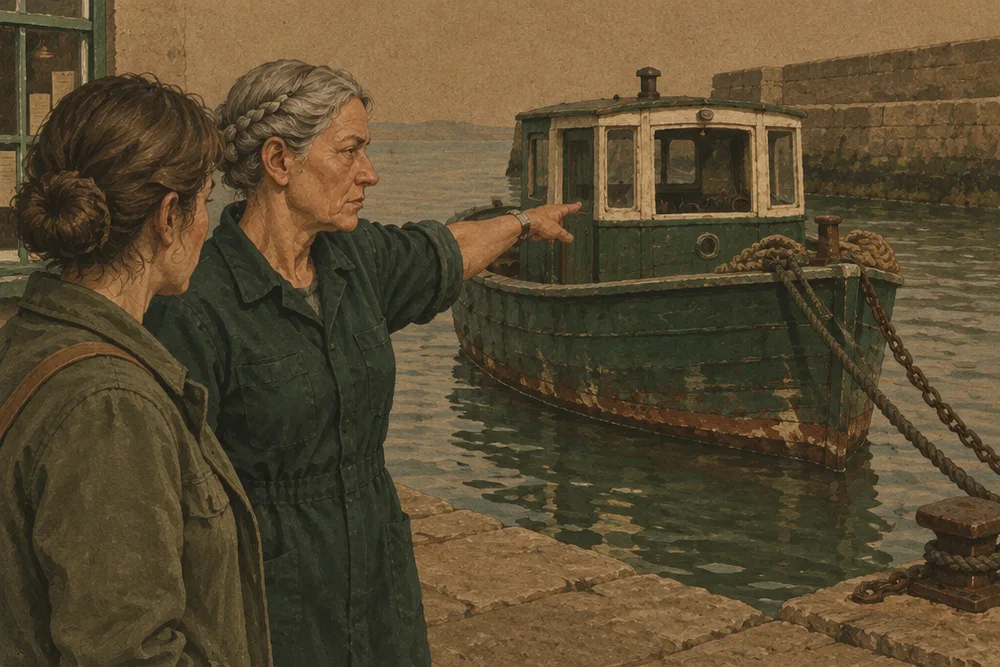
The reserve launch sat beyond the Tern’s stern, tethered to the quay by two dark ropes and a chain. From the ticket-room window, Merrin had always thought of it as a second answer to the same question: what if the first boat could not go? Its paint had blistered along the waterline. The little cabin smelled of damp rope and old diesel, though no one had started the engine in weeks.
She carried the green ledger out to the landing and found Nessa checking the Tern’s fuel cap. The tide was low enough to show the weed-dark stones below the quay. Nessa’s bottle-green smock pulled tight across her forearms as she leaned over the rail.
“We should sell the launch,” Merrin said.
Nessa straightened, chin first. “That’s not a small thing to say.”
“The verified claims are already bigger than what you offered Idris. The launch is worth money. It isn’t earning any.” Merrin kept her pencil between her fingers, its scored groove catching her thumbnail. She had written the figures on the back of an old fare sheet, then checked them twice against the bookkeeper’s subtotal.
Nessa looked past her to the spare boat. “It’s earning us the right not to strand the weekday contract.”
The district contract required a backup boat available for commuter runs if the Tern went out of service. The launch was not a luxury; it was the reason Nessa could promise the weekday timetable without promising that a single engine would never fail. When the Tern had once cracked a propeller, the reserve had carried passengers until the repair was done.
“You said it was lightly used,” Merrin said.
“It is. That isn’t the same as useless.” Nessa tapped the rail with one blunt finger. “The district checks our contingency. If we sell, they can say we no longer meet the contract.”
“Could we hire another boat when something breaks?”
“From upriver? At what notice? At whose cost? You’re counting sale money before you’ve counted what it takes to keep the service.”
Merrin looked down at the fare sheet. Her sums included a conservative sale price and the claims already verified. Even at the high end, the proceeds would not clear the whole debt. She had known that before she brought the idea out here. Knowing it did not make the shortfall less real.
“Then we find out whether there’s a way to keep the contract without keeping this boat,” she said.
Nessa’s mouth drew into a line. “You mean ask Orr.”
“I mean ask the person who writes the contract.”