What the Bell Owes
Chapter 4 · Bread Against the Bill
Page 32 of 210
Chapters
By the time Merrin reached Rusk’s Bakehouse, the morning tide had drawn down enough to leave the ferry’s landing steps dark and slick. She still had the green ledger’s copied rows folded inside her coat, the paper softened at the creases from being taken out and put away. A row of initials could mean a dozen things. Nessa had used the same neat M for Merrin, for Mother, and, once, for maintenance. The dates alone did not say whose hands had been on the deck.
The bakehouse door was propped open with a flour bucket. Warmth and yeast met her in the narrow passage, then the clack of a tray sliding onto the bench. Bette Rusk stood behind it, white curls cropped close, lilac cardigan buttoned to the throat. She sat upright even while working, one cuff powdered pale. A loaf cooled between her hands.
“You’re early,” Bette said.
“I thought you might have a minute before the counter opens.” Merrin stood with her ankles leaning toward the flour bench, coat still buttoned. “I’m checking some old ferry entries. I can’t tell who the initials belong to.”
Bette’s wide mouth tightened, not quite a frown. “That sounds like a question for your mother.”
“It is. But I’m trying not to put a name in before I know.” Merrin slid out a copy, keeping her thumb over the marks in the margin. “There’s a hatch-key number here. Do you recognize it?”
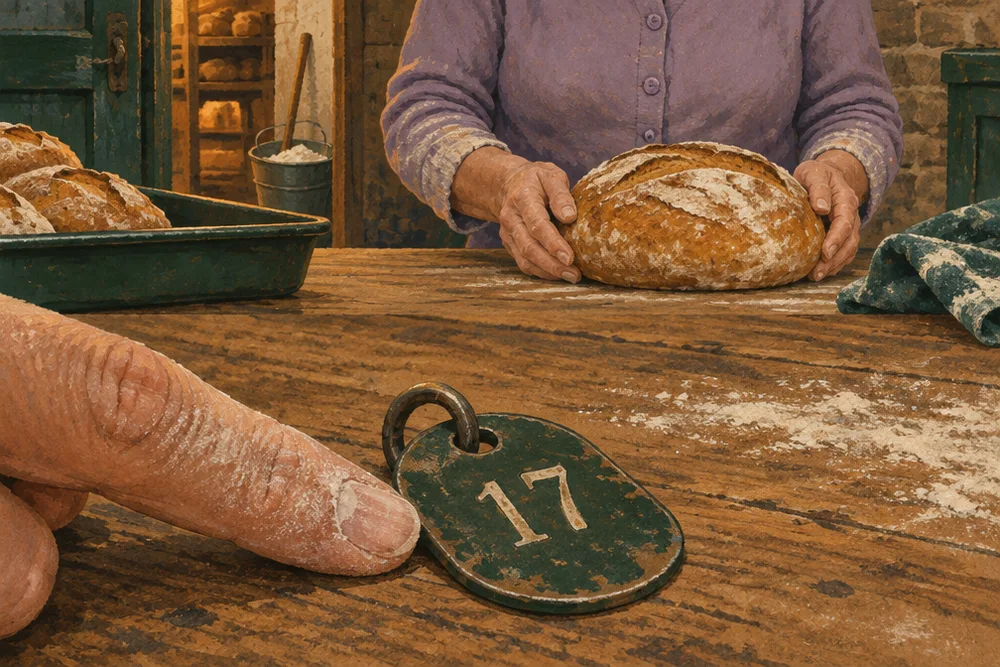
Bette wiped her hands on her apron before taking the copy. She did not reach for the loaf. Her finger followed the row, stopped at the little number written by the key return, and pressed once against the paper.
“That’s the back hatch key,” she said. “The one that stuck unless you lifted the latch with your shoulder.”
“You used it?”
“For months.” Bette handed the copy back without looking at Merrin. “Before I had the shop open. I’d go over after the first bread was in and do the floor, the rails, the seats. Your mother asked because I was already awake. Then because I knew where the soap was. Then because apparently it was part of the morning.”
Merrin looked again at the row. The dates were uneven, a run of weeks and then a gap, then another cluster. She had seen the same marks in the ledger beside her own initials. At the time, she had copied them into a column headed deck support, as if the heading could make them true.
“Did she pay you?” Merrin asked.