What the Bell Owes
Page 117 of 210
Chapters
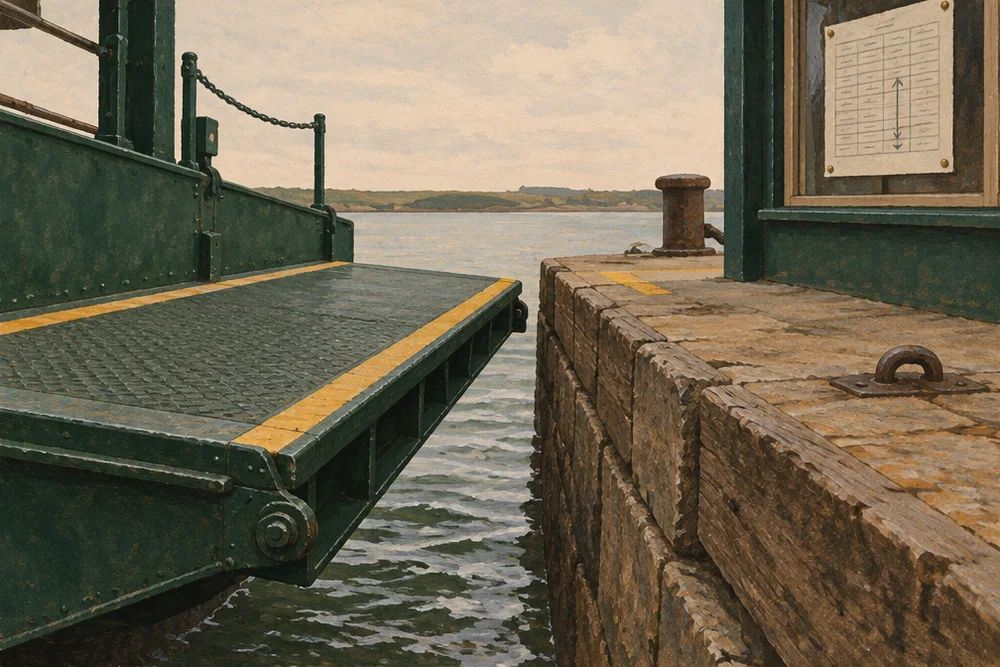
The last trolley crossed at eleven minutes. Merrin stopped the watch and wrote the figure on the back of the timetable. The cash model had assumed seven, because seven was a manageable number. The ramp had taken eleven because people and wheels were not columns.
Nessa watched her write. “You can’t charge them for being slow.”
“I’m not.” Merrin rubbed the pencil mark with her thumb, leaving a gray smear. “I’m finding out what we’re asking the crew to cover.”
They ran the test again with the boat empty, then with Nessa guiding the ramp up and down as if the tide had brought a full load. The trouble was not the crossing itself. It was the narrow interval at Low Steps: the boat could hold there only while the water left the ramp at a usable angle. Beyond that, the end began to lift from the landing, and a trolley would have to be hauled rather than rolled.
Merrin marked the waterline against the ramp’s lower hinge. “If we leave later, we arrive closer to the turn.”
“Closer isn’t the same as beyond it,” Nessa said. She moved the ramp by hand, testing its weight. Her chin led her as she leaned out to check the landing. “Give me the time you want to try.”
Merrin gave it. Nessa checked her inward-worn watch, then the tide marks on the stone. They waited through the passage of a low barge, its engine shaking the water under the quay. When it had gone, Nessa eased the Tern to the landing again.
The ramp settled against the stone at a steeper angle. Merrin carried a wooden crate across it, then pushed an empty trolley back. The wheels rattled, but held. Nessa watched the gap between ramp and landing instead of Merrin’s face.
“It’ll work for nine minutes,” Nessa said. “After that, I won’t promise it.”
Merrin wrote nine in the margin. It was not a timetable yet, only a limit. She imagined the ferry late, a passenger waiting with a trolley, and a paid relief skipper watching the minutes go past. The limit would have to be printed beside the departure, not hidden in a calculation.
“If we publish it as a trial,” she said, “we can cancel the stop when the tide makes it unsafe.”
Nessa looked toward the Low Steps houses, their windows stacked above the river wall. A person could take the bridge detour, but the bus route added nearly an hour to a short crossing. A timetable that treated the ramp as a convenience would be useless to anyone who needed the ferry for an actual errand.