Three Bells Below the Salt
Page 6 of 249
Chapters
She set her cup beside the inkpot. “Could I see the prior week’s receipts?”
“You can see the receipts you’re assigned to copy.”
“And the rope invoice?”
“You have already seen the entry.”
“There isn’t an invoice attached.”
“Then there isn’t one.”
Luz took off her spectacles and cleaned them with a corner of her sleeve. Without them, her eyes seemed paler and more tired. “Ridgeveen, you came here for wages. You’ll get them. Don’t confuse a job with a promise that every part of the place will explain itself to you.”
“I don’t expect that.”
“You look as though you do.”
Tessa gathered her cup. She had the urge to say that she expected a bell to have a bell, at least. But the line sounded childish even in her head. She walked out to the yard without replying.
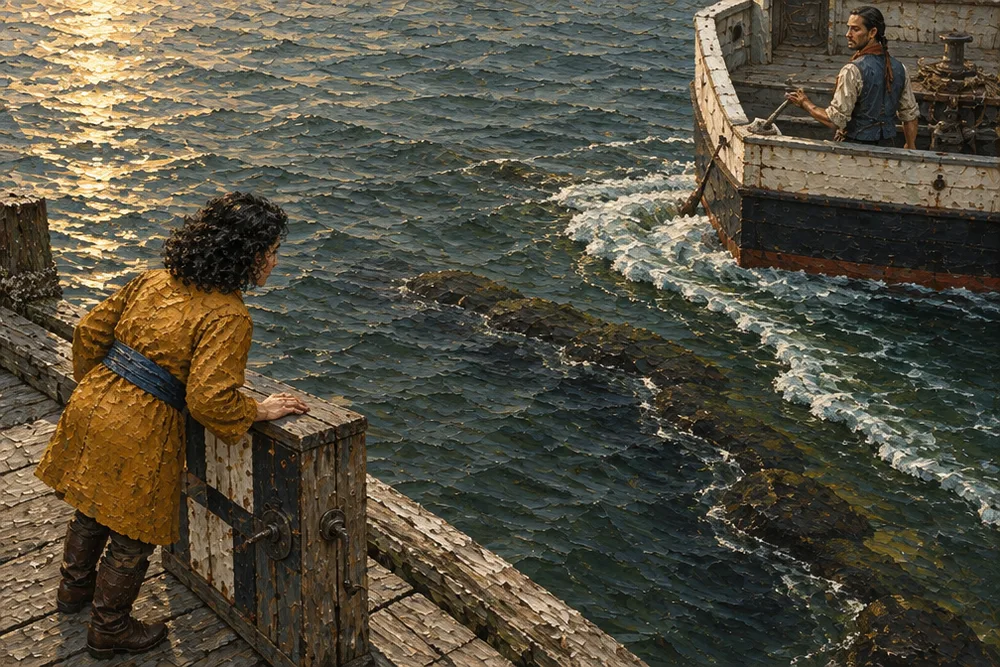
The evening ferry carried six passengers and two crates of lamp glass across the basin. Tessa worked the landing board while the ferryman brought it in, reading the surface for wind shifts and the shallow darker bands where old channels cut through the salt. The water at the west landing was not deep, but a bad approach could grind a hull against the buried stone lip.
The ferryman, Zacarías Walker, had a long-legged, spare build and a silver-streaked black braid tied down his back. His indigo vest was faded at the seams; a rust-colored scarf sat loose around his neck. When he stepped ashore, he put his weight on his heels, as though the ground were no more trustworthy than a deck.
“Your line’s too far north,” Tessa called. “You’ll catch the lip.”
Zacarías glanced at the landing board. He corrected the angle with a small pull on the tiller. The ferry eased into the berth without a scrape.
“You see that from there?” he asked when he stepped out.
“I can see the wake.”
“The wake lies.”
“Not always.”
He gave her a brief, unreadable look. “No. Not always.” He unloaded the crates without asking her to help, though she carried the lighter one anyway. His narrow chest seemed made for long distances rather than heavy lifting, but he moved with a ferryman’s economy and did not waste a step.
The passengers went toward the settlement. One stopped to ask whether the cistern had water. The keeper answered that the ration had been cut again. Zacarías heard it and said nothing. His face, oblong and lean, held the weariness of someone accustomed to hearing what could not be changed.