Three Bells Below the Salt
Chapter 19 · Salt for Timber
Page 199 of 249
Chapters
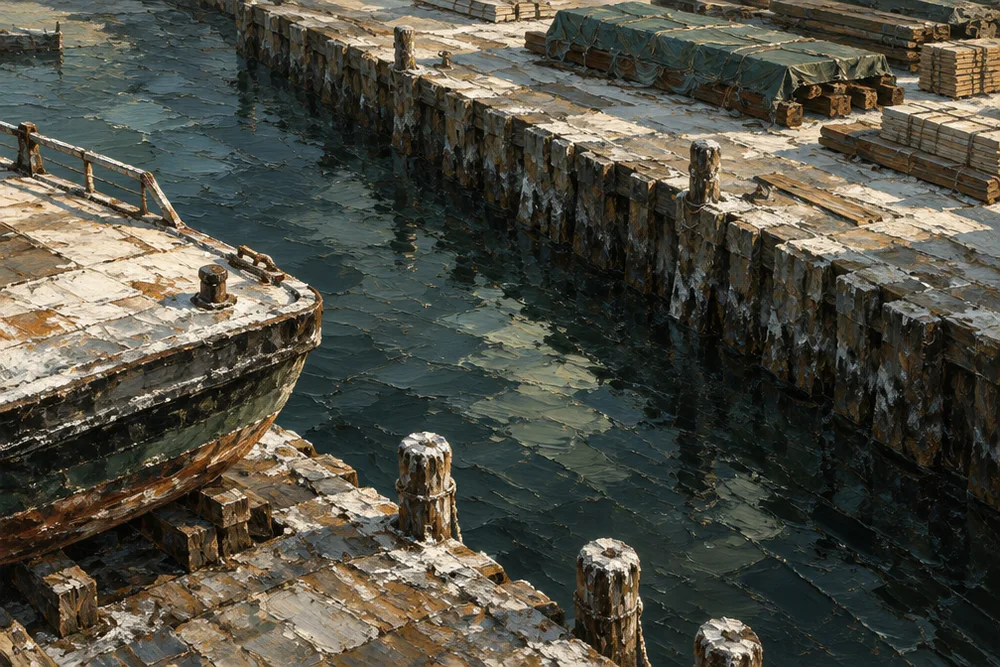
The east landing was close enough to see from the ferry office and too far to reach by boat. Between it and the west flats, the flooded cut ran dark beneath a crust of salt and broken timber. Its current worried at the banks, tugging at reeds and old mooring posts. The ferry that had once crossed it sat above the west landing on blocks, its stern bare and its deck scabbed with dried brine. No one was taking it out until the lower branch was sealed and the new rudder fitted. No one could fit a new rudder until timber came across.
The timber had come by packet that morning: long, straight beams stacked under tarpaulin on the east landing, with shorter boards lashed in bundles. Tessa Ridgeveen stood on the west bank, mustard oilskin snapping at her elbows, and watched the packet pull away. Its wake flattened against the landing stones. The deckhand who had stayed behind lifted a hand in farewell; she lifted hers back, then looked down at the gap between them.
“We can wait for the cut to fall,” said one of the ferry hands. He had a coil of rope over his shoulder and a white line of salt dried across his boots. “If it drops enough, we’ll float a skiff across.”
“And if it doesn’t?” Tessa asked.
He looked at the ferry’s broken stern. “Then we wait longer.”
Behind them, the people camped around the cistern were making the day’s water last. Families from the quarry lived in the empty rope warehouse and under canvas along the west wall. Their houses had been under the salt crust; their new homes were a promise written in Luz Reymara’s ledger, not yet made real. Every day without roofs meant damp blankets, crowded sleeping places, and arguments over whose bucket had been filled first. Every day without the ferry meant no regular trade, no packet connection, and no reliable way to carry goods between the landings.
Tessa had learned to distrust the word wait. It was often what people called a decision that left the cost with somebody else.
“We can carry it over the ridge,” she said.
The ferry hand gave her a look that traveled from her square shoulders to her short, thick forearms. “Those beams?”
“Not all at once.”
“The ridge path is a goat track.”
“Then we’ll make it a path.”