Three Bells Below the Salt
Chapter 18 · The Price of Dry Ground
Page 190 of 249
Chapters
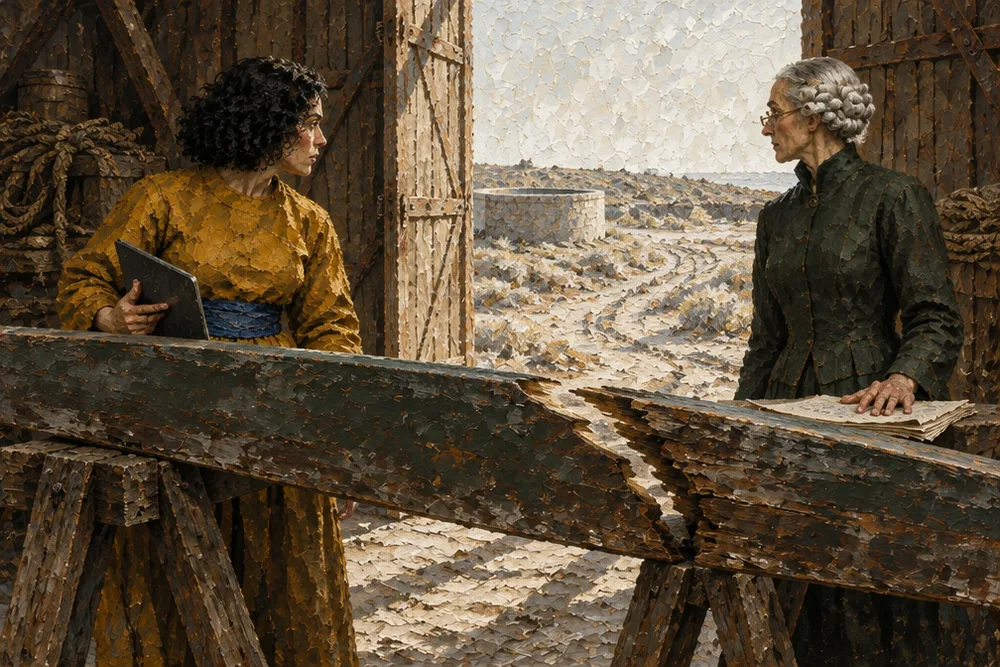
The ferry’s rudder lay across two trestles in the rope warehouse, its split blade propped open like a broken jaw. Two ferry hands had found it wedged beneath the west landing when the water fell. One of them had pried it out with a boathook and carried it up with the broken pin still caught in the hinge. Tessa Ridgeveen stood beside it with a slate in one hand and a carpenter’s estimate in the other. The numbers on the estimate had been revised twice. Each time, the total grew.
Outside, the rescued families were making a settlement out of whatever the cistern yard could spare: blankets hung on cart poles, cooking pots balanced on stones, children sent in pairs to fetch water. The rope warehouse had given them a roof and a floor, but not a future. Its broad doors opened on the ferry landing, and every time a gust pushed salt dust inside, the people nearest the entrance looked up as if a door might also be a promise.
Luz Reymara came through with her coat buttoned to the throat, brass spectacles catching the white glare. She set a folded account sheet beside Tessa’s slate. “The gate crew returns in three days. They’ll want the ferry moving and the cut reopened.”
“The cut stays sealed,” Tessa said.
“I know what we agreed after the rescue.” Luz’s long fingers pressed flat on the paper. “I also know that agreement doesn’t repair a rudder, buy timber, or put these people under roofs that belong to them.”
Tessa looked past her, through the open doors, to the west ridge. It rose beyond the cistern in a pale, broken line. The ground along its foot was hard and high, crossed by old cart ruts and a strip of scrub where saltbush grew in crooked tufts. She had seen the ferry crew turn their wagons there when the landing yard flooded. Dry ground. Close enough to the cistern to carry water. Close enough to the ferry to bring supplies without crossing the cut.
“Who owns that strip?” Tessa asked.
Luz followed her gaze. “The ferry office.”
“All of it?”
“The west shoulder, yes. It was meant for a second storehouse that never got built.”
Tessa put the estimate down. “Then that’s where the houses go.”
Luz’s expression did not change, but her attention sharpened. “You’ve seen the survey?”
“I’ve seen the water.” Tessa tapped the slate with the chalk. “The cistern yard stays dry because it sits above the basin floor. That shoulder is higher. The cart ruts already make a route from here. Put the houses there, and the families aren’t sleeping in a warehouse that has to be emptied every time you need to store rope.”
“It’s not surveyed for housing.”
“Then survey it.”
“A survey costs money.”