The Widow Window on the Landing
Page 83 of 224
Chapters
Aster returned to the landing with the receipt folded in her pocket and the umbrella’s position sketched in her notebook. She wanted to see whether the other loading door responded to the same disputed object. Nella waited behind the pane with the lamp on the lowest tread. The warm light made her face visible without softening its sharp, tired planes.
Aster wrote: I AM TESTING THE DOOR. A DISPUTED OBJECT MAY HOLD IT OPEN.
Nella read the sentence. Her mouth tightened. She set the lamp on the floor and wrote back: IT MUST BE CLAIMED BY BOTH SIDES.
“No one has claimed the umbrella,” Aster said aloud. She pointed toward the rear of the house, where Iven stood out of sight. “It belongs to a former tenant, if anyone. We don’t know which.”
Nella rubbed the chalk away with the side of her hand. Then she wrote: THAT IS NOT THE SAME AS NO CLAIM.
Aster copied the sentence. The distinction mattered. Aster had treated uncertainty as a blank space, something an inventory could leave empty. Nella appeared to regard it as an active condition, an unresolved claim that had to be held open rather than erased.
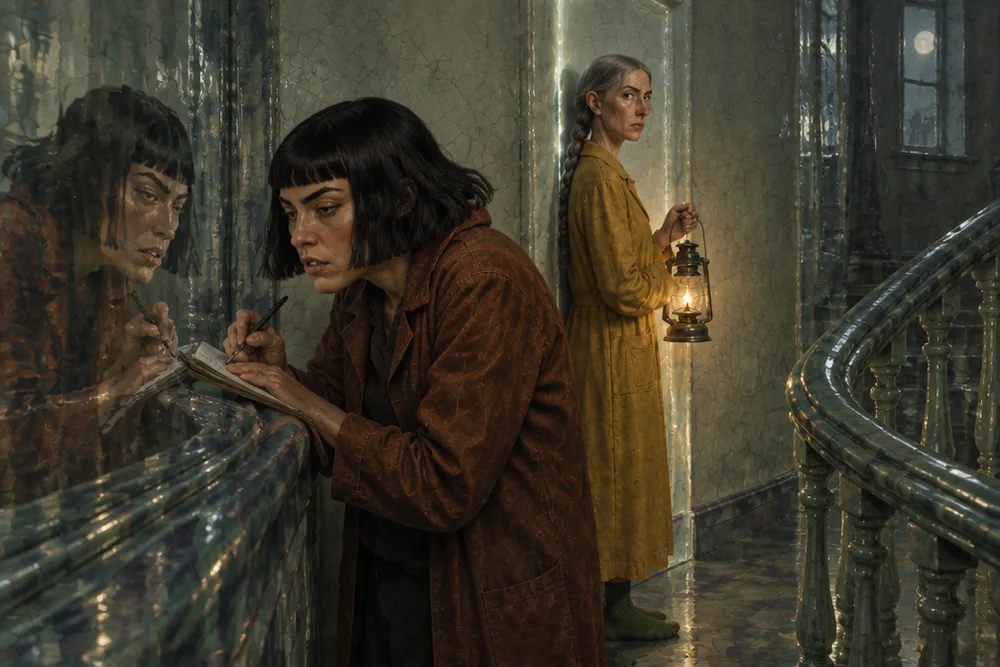
“Can you show me the door?” Aster asked.
Nella lifted the lamp. The light moved along the far wall, and a narrow seam appeared beneath the stairs. It was not a door opening, only a pale rectangular line, like the outline left after a door had been removed. Nella tapped the glass at its center, then pointed down toward the rear of the house.
Aster went back downstairs and tried the loading door. It resisted her hand, but the latch had not shifted. She returned to the landing and described the seam. Nella wrote: THE DOOR IS THERE WHEN THERE IS A RECEIVER.
Aster thought of the receipt’s wording: Door held until receipt completed. A return required someone to receive, someone to acknowledge what crossed, and an object whose custody remained unsettled. She had no living recipient prepared to stand outside. She did not have the lamp. Nella would not release it while the counterhouse households still relied on her inventory.
The facts were not yet a method. They were, however, more than a reflection theory. Aster had a door that responded to an object with no settled owner. She had a lamp whose passage had once been recorded by receipt. If she could keep the threshold from closing, perhaps a person could be received—but every claim in the paperwork warned her that an attempted crossing might settle something she meant to preserve.
She wrote a careful question on the pane: IF THE DOOR OPENS, CAN SOMEONE COME THROUGH?