The Widow Window on the Landing
Chapter 7 · NOT YET
Page 80 of 224
Chapters
Nella’s chalk marks had faded where the glass sweated, but the last one remained legible: NOT YET. Aster stood on the landing with her notebook braced against the banister and read it again. Below, the lamp in the other staircase rested on the tread above the foot. Its shade was a dull cream, its brass neck freckled green. The dent in its base caught a small bar of gray daylight.
“You said you would lower it,” Aster called, though she knew Nella could not hear a voice through the pane. She lifted her pencil and wrote beneath the chalk: WHAT MUST HAPPEN FIRST?
For a long minute nothing answered. Then, in letters that appeared as though a finger were writing through fog, Nella’s reply came: THEY ARE STILL USING IT.
Aster looked down the gallery toward the shut rooms. The occupants of the counterhouse were not shadows in a story. They were households catalogued in the owner’s ledger, their departures stamped complete and their rooms listed empty. In Nella’s marks, they remained people with cupboards, curtains, meals interrupted and names that Aster had been told not to publish. She had crossed out only those names backed by signed collection receipts. Even that small act had lowered the lamp a tread.
“The handover is in two days,” she said. “If the owner closes the lines, the names will go whether I write them down or not.”
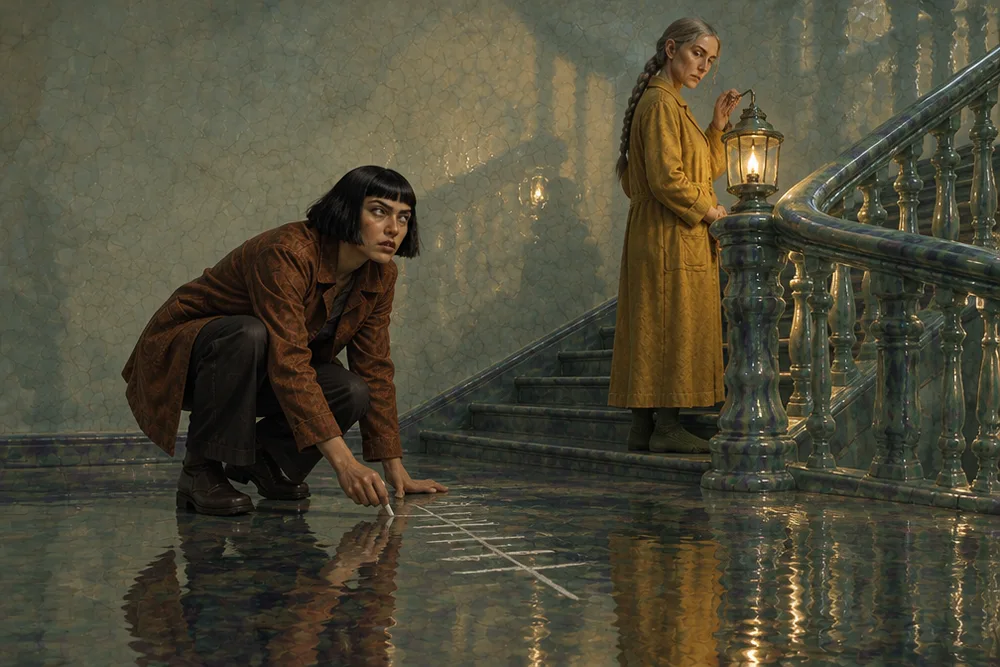
Nella set one hand against the far side of the glass. A narrow hand, the knuckles pale. Her other hand held the lamp’s handle. She stood heel-to-heel, shoulders squared, mustard housecoat loose around her tall frame. One green sock showed below the hem. Her face was turned so that the bent line of her nose pointed toward Aster.
Nella wrote: IF I LET IT GO, THEY LOSE THE ONLY LIST THAT SAYS THEY WERE HERE.
Aster’s pencil hovered. She understood the fear. A ledger could be a trap, a weapon, or the one proof left after a room had been emptied. She knew this because she had built a business on signatures and watched one disputed clearance ruin it. Still, keeping the lamp—and the people whose names it held—inside the counterhouse was not a remedy. “We have to find a way to make the passage last,” she said.
Nella shook her head once, not refusal but warning. The lamp’s flame wavered without a draft. Behind it, the other staircase descended into the same bone-colored hall, its glazed banister bent in the reflection like a river held under ice.