The Widow Window on the Landing
Chapter 14 · No Trunk, No Departure
Page 167 of 224
Chapters
The refusal came through the pane in block capitals, each letter blurred at its edges by the crazing in the glass: NO TRUNK, NO DEPARTURE.
Aster Morlenne held the chalk still. On the other side, in the counterhouse landing, the lamp burned at the foot of the reflected stairs. Its dented brass shade cast a small, steady pool of yellow across the floor. Behind it waited the three households whose names had been restored from the owner’s replacement ledger: the Dace family, the Venns, and the two surviving members of the Olt household. They had agreed to leave together. Now the broad-shouldered man in the work shirt—Mr. Venn, though his own name had been smudged once and written in again—stood with his hands braced on the counterhouse banister.
“We will not go without it,” he said. His voice came thinly through the pane, as though spoken into a cup. “It was in our room when they shut the door. It was there when we packed. We’re not leaving it for her to keep.”
Nella Pell stood behind him, straight and heel-to-heel in her mustard housecoat, one green sock visible below the hem. She kept both hands at her sides. She did not look toward Aster. The lamp lit the bent line of her nose and the gray braid resting against her shoulder.
“What trunk?” Iven asked from the real landing.
He had come up behind Aster without her hearing his felt slippers on the stairs. His plum cardigan hung open over his barrel torso; one drooping eyelid had sunk nearly shut. He leaned backward as if the building had begun to tilt toward him. “There wasn’t a trunk in that room when I cleared it.”
Aster lowered the chalk. “You told me you never cleared the room.”
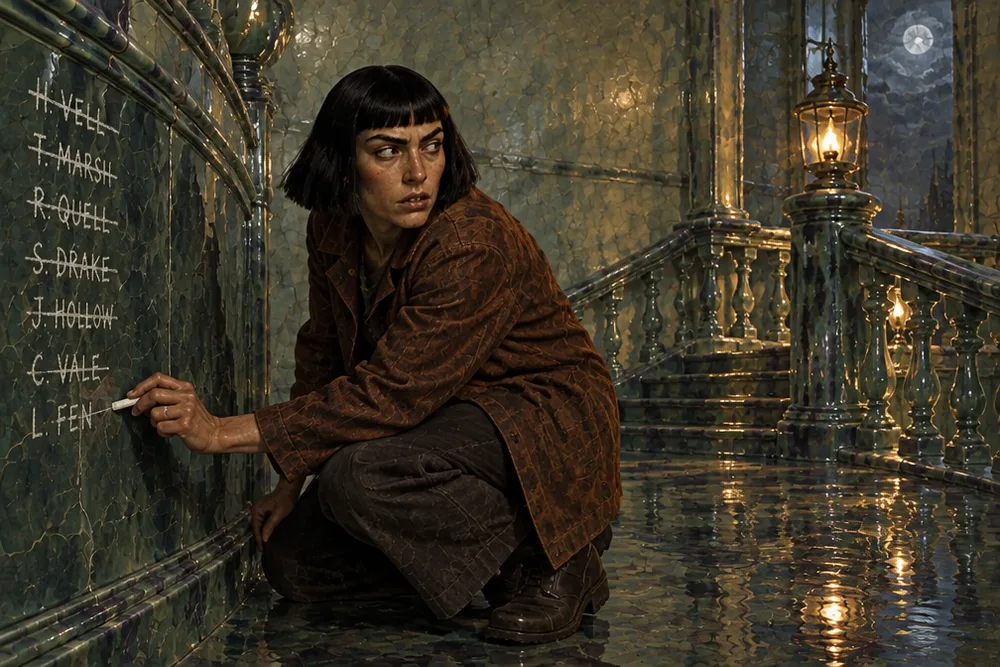
“I said I didn’t take anything.”
“That is not what you said.”
He glanced at her, then at Nella’s dim figure beyond the pane. The cracked glass warped the distance between them but left their faces where they belonged. Nella’s expression did not change.
Suri Dace crouched beside the stair rail, teal rain shell creasing at the shoulders. Her compact frame made a hard angle against the banister. She had the restored carbon sheets spread over her knees, weighted with a brass doorstop. Her black undercut curled over her crown, damp from the mist outside. “Which household?” she asked.
Mr. Venn looked past her, toward the pane. “Ours.”
“Your name?”
“Elias Venn.” He said it sharply, as if the name itself ought to be enough to open the door. “My wife was Mara. We had a room above the kitchen. We paid for a trunk and three chairs. The chairs are on your papers.”