The Widow Window on the Landing
Page 8 of 224
Chapters
The lamp still burned behind the pane. Its light warmed the small patch of reflected stair, though it did not warm the hall. Aster stood on the landing with her clipboard beneath her arm and thought of the van. She pictured the fee, the yard clerk’s red box, the chain around the steering wheel. She pictured the forms signed and dated, the clearance finished, the money in her hand. Seven days was not a long time, but it was enough time to do the work if the house behaved like a house.
She went down to the front hall and checked the door. It was locked. She checked the lodge and found Iven’s slippers placed neatly beside its threshold. The house had the stillness of a place where someone was listening for a familiar footstep.
Aster went back upstairs. At the landing, she turned her back to the pane and looked at it in the black surface of the gallery window. The second stair was visible there too: a pale, distorted corridor, the lit lamp caught at the edge of the glass. She shifted her weight. The image warped. The lamp did not move.
She looked over her shoulder. It remained on the same tread.
Aster considered taking the mirror and setting it at the opposite end of the hall, but Iven had put it away, and she had no reason to force the matter tonight. More important, she needed to know whether the pane’s image changed under morning light. She needed an angle measured, not guessed; a record made before any more arguments.
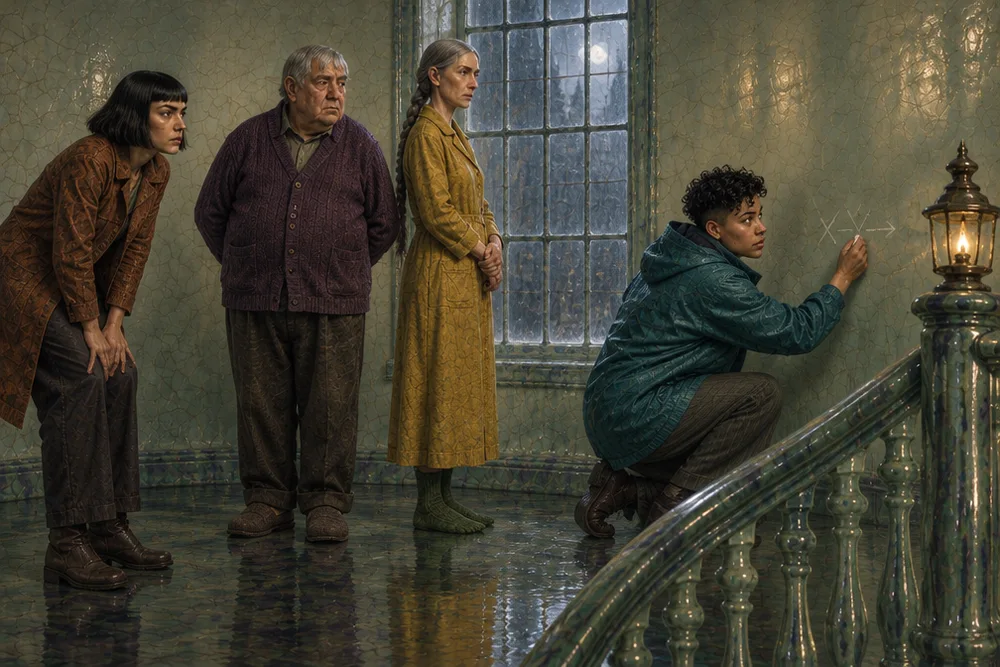
She took a length of chalk from her case and marked a small cross on the wall beside the window, where the plaster was already scarred. Then she drew a short arrow pointing toward the pane. The mark was no larger than a fingernail. It gave her a fixed place from which to repeat the test.
Back in room six, she laid the clipboard on the desk and wrote the date across a fresh page. Under it she wrote: landing window—angle test at first light. She signed her name below the note, not because it was a conclusion, but because it was hers.
Before bed, she went over the contract once more. The owner’s name was at the top, written in a looping hand. Below it, the deadline. Below that, the amount of the clearance fee. The final clause said that payment would be made after delivery of a complete, signed inventory and confirmation that all listed occupants had departed.