The Widow Window on the Landing
Page 77 of 224
Chapters
“Suri’s coming back with the rest of her records,” Aster said. “She says her father never got his deposit.” “She was a child.” “She remembers his chair in the room after he was supposed to have left.” “People leave things behind.” “Not their whole lives.” Iven’s mouth tightened. His hand slipped from the door. “You can’t use a memory to hold a house.” “I’m not trying to hold the house.” “Then what are you trying to do?” “Keep the owner from declaring a claim settled when there’s no receipt for payment.” He looked past her, at the glass. For an instant she thought the yellow lamp had brightened. Then the clouds shifted over the roof, and the light in the stairwell changed with them.
When Aster went to the landing, the pane showed the lamp as plainly as it had the day before. The light warmed its glass chimney; the brass base carried the dent. At the foot of the opposite stairs, an empty stretch of tread remained between the lamp and the landing above. No figure stood beside it. The reflection’s proportions were wrong in the familiar ways: the banister swelled, the stairwell narrowed, the walls held hairline crazing that the real walls did not. Aster could see nothing that proved a person lived there. She could see the door she had noticed before.
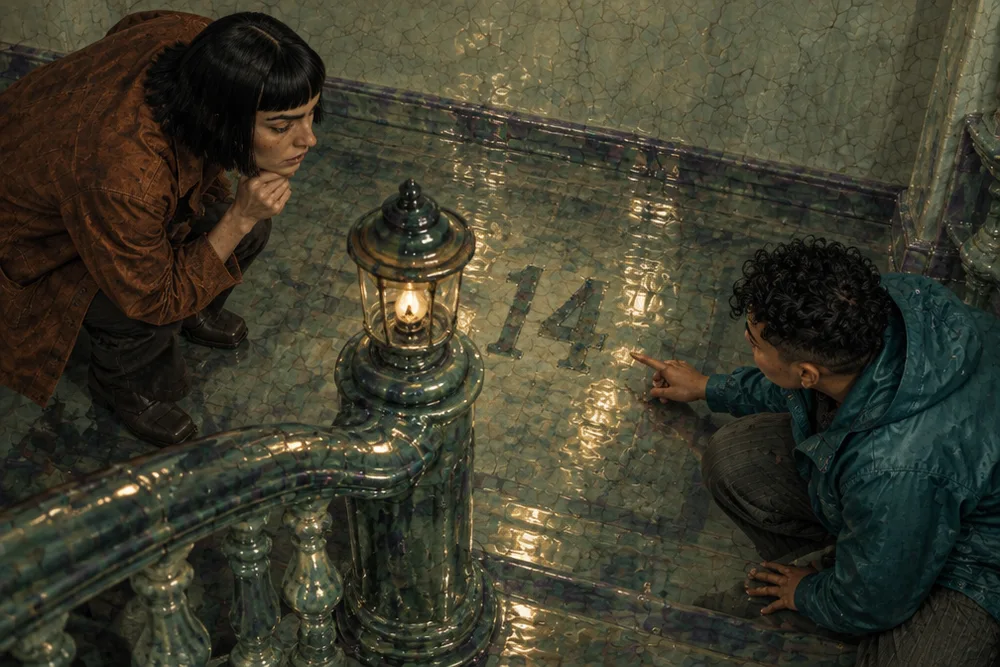
She took the room 14 carbon from her pocket and held it close to the pane. The lamp’s light passed through the thin paper and made the type ghostly. Aster had not expected a reaction, but the far door sharpened. Its outline had the same tide-green color as the paint on this side. It sat directly across from the room on the gallery, though the two doors could not line up in any ordinary reflection. The number plate on the far door was visible, faint but unmistakable: 14. Aster felt the paper tremble between her fingers.
“Suri,” she called. Suri appeared at the top of the stairs, carrying her document case. “Look.” Aster lowered the carbon so the room number was visible to both of them. Suri crouched, bringing her face level with the pane. Her hands rested on her knees. The pane transmitted the glow and the writing, not bodies; on the other side, the door stood still and closed. Suri squinted at it. “That’s his room?” “The number is 14.” “It wasn’t there yesterday.” “I saw the door yesterday. Not the number.” Suri leaned closer, but did not touch the glass. “Can you read anything else?”