The Widow Window on the Landing
Page 65 of 224
Chapters
>From the upper gallery came the dry scrape of a chair being moved. Aster’s attention snapped toward the sound. There was no one in the visible corridor, only closed doors and the bone-colored walls, their glaze crazed with hairline seams. The scrape came again, directly above them, followed by a soft thump.
“What’s in room six now?” she asked.
Iven rubbed his palms together. “Nothing of hers.”
“The inventory says the wardrobe and bedside table are still there.”
“The owner’s things.”
“Then why are they assigned to Nella?”
“They were in the room.”
Aster went to the foot of the stairs and looked up. The lamp in the pane seemed to burn brighter, though the reflected light did not reach the real stair. She did not climb. Nella had told her not to open the door, and Aster had no reason to turn that into permission to force another one.
She returned to the inventory sheets. The name Nella Pell appeared at the top of the first page, then again beside the bedroom contents. Across the bottom ran the owner’s instruction: certify all rooms empty of personal effects prior to handover. Below it was Aster’s own blank signature line.
Her pencil rested over the word empty. “If I complete this as written, what happens to the people in the other rooms?”
Nella’s figure remained still. The glass offered no answer.
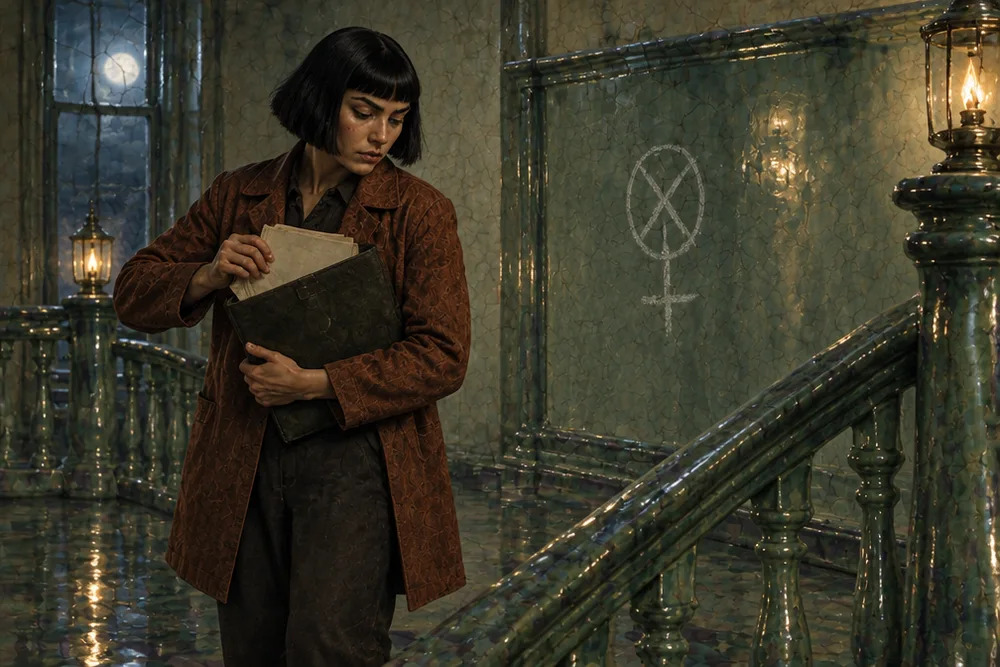
Iven said, “There are no other people.”
The counterhouse stair behind Nella turned away into darkness. Aster thought of the bootprint on the empty tread, the repeated packing of a drawer she had not seen, and the names on the missing-property forms. The house had held the tenants’ rooms as surely as it held their furniture. The people might be present in the same stubborn, unfinished sense.
“You don’t know that,” Aster said.
“I know what’s in this building.”
“You know what’s in this one.”
Aster picked up the inventory sheets and slid them into her work folder without signing. She would not certify a room empty merely because the person who belonged to it could not put a hand on the paper. That was not proof. It was not even a solution. It was a refusal to help the owner close a claim she could no longer pretend she hadn’t seen.
From the pane came a slow, pale line of chalk. Stop the clearance.
Aster looked at Nella. “I can suspend the work, but the owner may not accept it.”
Then do not come through.
The message remained, stark and clear, as if Nella had placed a hand against the other side of the glass.