The Widow Window on the Landing
Page 44 of 224
Chapters
The lamp did not. Its little halo held steady against the far wall, and the bright crescent on its base was turned toward her. Aster walked down three steps. In the pane, the rail moved across the lamp, but the lamp remained visible through it, as if the stair and the light belonged to separate depths.
She fetched the small inspection mirror she used to see behind radiators. It had a nicked silver backing and a handle wrapped in black tape. Back on the landing, she angled it toward the pane. The mirror caught a strip of glass, then the counterhouse’s far stair. She shifted it until the reflected hall slid out of view. The counterhouse stair vanished from the little mirror, as any reflection should.
The lamp remained in the pane.
Aster set the inspection mirror down. Her face floated pale in the cracked glass, triangular and too close, the chipped corner of her front tooth visible when she pressed her lips together. She turned her head to each side. The pane gave her the landing, the window at the street end, and the stairwell behind her. It did not give her a lamp.
“You said the mirror would show what was there,” she said.
Iven had come halfway up. “I said you were seeing a reflection.”
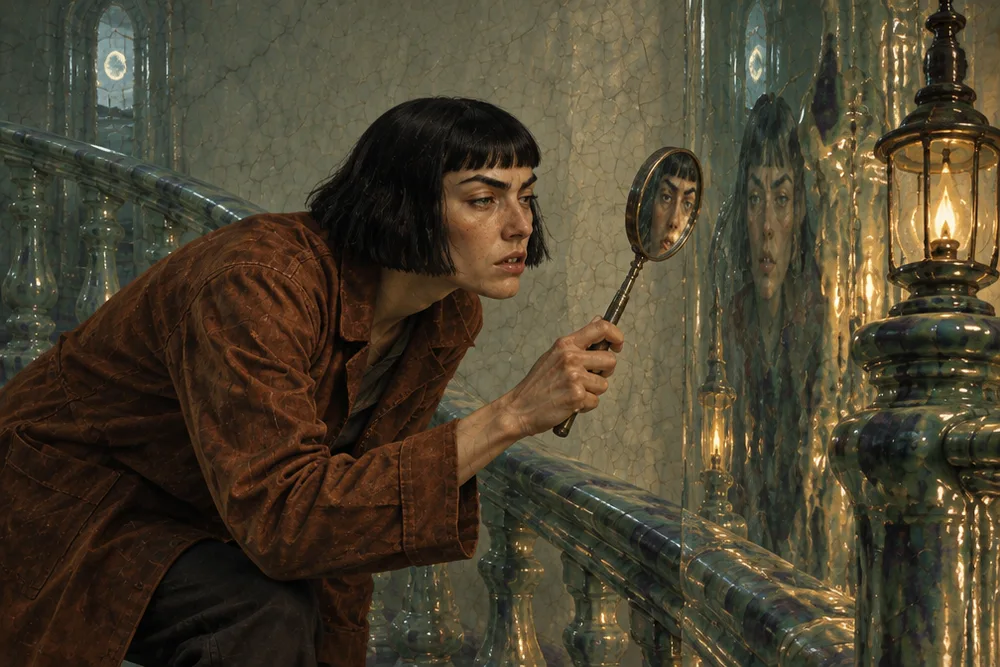
“I moved the angle until the stair stopped reflecting. The lamp stayed.”
“Old glass.”
“I put another mirror across it. The mirror reflects the pane and not the lamp.” Aster kept her voice even. There was no advantage in making a man defensive before she had his evidence. “If the lamp were a reflection, it would be in the mirror.”
Iven’s gaze went past her shoulder to the pane. His drooping lid narrowed. For an instant he looked not frightened but caught in the act of counting. Then his face settled into its usual guarded oblong. “You can make anything look strange if you keep at it long enough.”
“That’s true,” Aster said. “It’s why I’m testing it.” She made a note on the duplicate sheet: mirror moved; image altered; lamp stationary. It was not proof of what the lamp was. It was proof that Iven’s explanation did not account for what she had seen.
The owner’s duplicate sheet had a carbon impression beneath the ink. Aster tilted it toward the landing window and read the faint pressure marks, most of them from the original ledger. Beside room eight, someone had written collected, then crossed it out. Beside room eleven, the same hand had entered cleared. She knew the little hooked C: the owner’s clerk used it on every form.