The Widow Window on the Landing
Page 32 of 224
Chapters
“You can’t access the annex without a request number,” Suri said. “The public file is the register. The carbon copies are downstairs in the restricted stacks.”
“You work there.”
“I work at the housing records desk. That doesn’t make the stacks mine.”
“Could you make a request?”
“For my own father? I can make one. I can’t guarantee it’ll be granted before the owner’s handover.” She tipped her face toward the stairs. “And I’m not giving you access to his file so you can publish his name.”
“I don’t publish names.”
Suri’s eyes moved to the open notebook again. “A catalog becomes a record. A record travels. A person can be exposed by an inventory even if their name is left off.”
Aster knew that was true. She had once catalogued a room by describing a child’s school uniform, a medicine bottle, and a stack of unpaid letters. The family had asked for the document later to settle the estate; a distant cousin had found it first. Aster had not included the child’s name. That had not made the details private.
“What would you want me to leave out?” she asked.
“The names. The addresses. Anything that would let somebody identify a household without permission.” Suri crouched to pick up the third loss form, studying its lower margin. “Keep the numbers if they matter. Keep the dates. But ask before you make a person public.”
Aster watched her read the red return stamp. Suri’s fingers held the paper by its edges, careful with the weakened fold. “Your father’s form is one of these?”
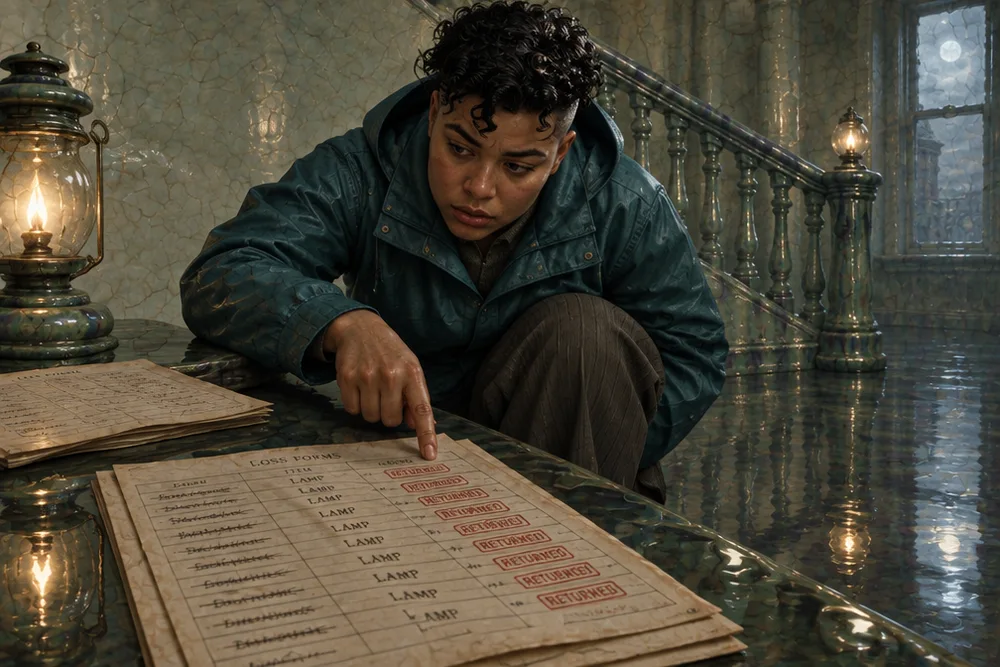
“No. His is a departure record. The missing-property report was filed by my mother afterward. A lamp, she said. Brass, green shade, one dent in the rim. The city marked it located, then returned to circulation.”
The lamp’s description came back with such precision that Aster stopped breathing for a moment. She put the three forms beside one another. “You’ve seen the report?”
“The carbon. My mother kept a copy. The original was in the building file.”
“And the lamp?”
“We never owned one.”
Aster turned to the forms again. Three households, three dates, the same dent. She asked the question carefully. “Did your father leave on moving day?”
Suri’s mouth tightened. “The register says so.”
“I mean, was he moving that day?”
“He was supposed to collect a key to a room across town. He had a suitcase. My mother was waiting at the new address. He never arrived.”
“And the other households?”
“I don’t know.”