The Widow Window on the Landing
Page 23 of 224
Chapters
Aster pulled the owner’s copy from its folder and placed it beside her own. She did not alter either one. In the margin she wrote a question mark beside the crossed name, then immediately disliked the ambiguity. A question mark could mean uncertainty about the person, the effects, or the date. She struck through it once and wrote “departure status unverified.” That phrase was exact enough to be useful.
She went room by room through the upper gallery, checking the names against the objects and the owner’s duplicate. Wherever the room was visibly empty, she did not add a departure mark. Wherever belongings remained, she described them and left disposition unresolved. In Room Nine, she counted the cup’s tea stain and recorded the stockings as two, folded, clean. She did not enter a name as collected merely because the room had been empty for years.
At the end of each line she initialed only the physical count. The departures column stayed blank. This was not what the owner had asked for. It was the only way she could continue without pretending that the owner’s broad categories answered the questions in front of her.
From the landing, the lamp held its lower tread. Aster looked at it once every few minutes, never long enough to lose track of the paper in her hands. She kept the sketch, the observation page, and the duplicate sheet in separate folders. The separation mattered. If one became damaged, the others would retain their own evidentiary value.
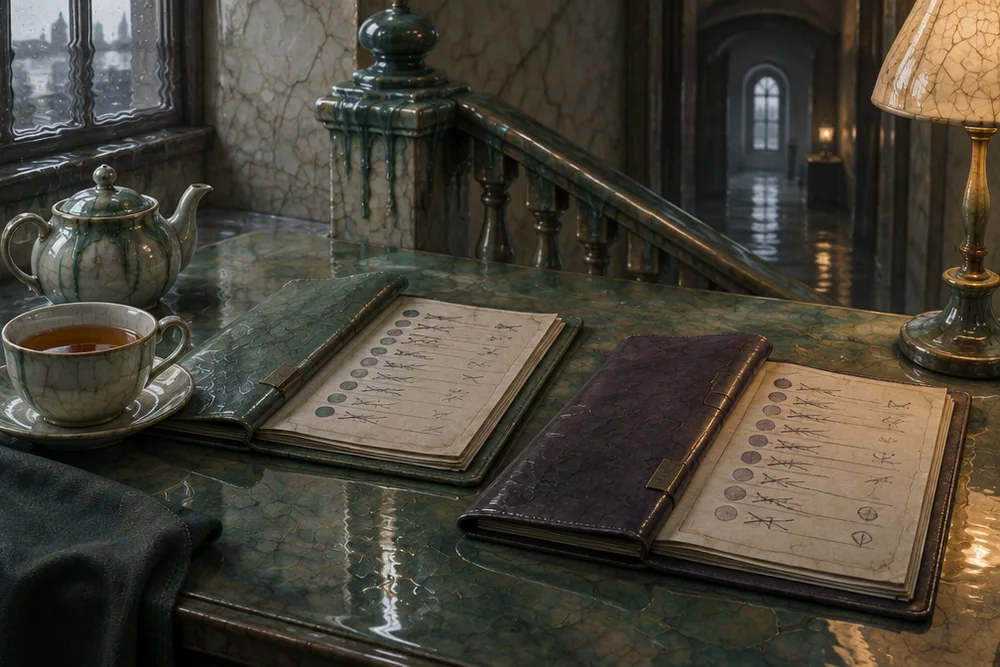
Just before evening, Iven brought up a tray with a pot of tea and two cups. He set it on the low table without looking at the window. One cup had a fine crack at the rim. Aster thanked him and asked whether he wanted to read her notes. He said no.
“I’m not certifying departures,” she told him. “Not until I know what the marks mean.”
“You can’t stop the owner’s clearance.”
“I can stop my signature.”
“That won’t stop anything.”
His voice was quiet, not angry. The admission sounded more like a warning. Aster wrote it down after he left. She did not drink the tea. Its surface cooled, reflecting a small, ordinary square of the landing window.
Night came early behind the clouded windows. Aster worked under a desk lamp in the room she had been given, a narrow spare room with a washstand and a bed too short for her. The contract lay on the chair beside her coat. Its seven-day deadline was printed in bold at the top. Her fee, stated beneath it, was enough to retrieve the van from the municipal lot and cover the storage charge that was accumulating by the day.