The Widow Window on the Landing
Page 208 of 224
Chapters
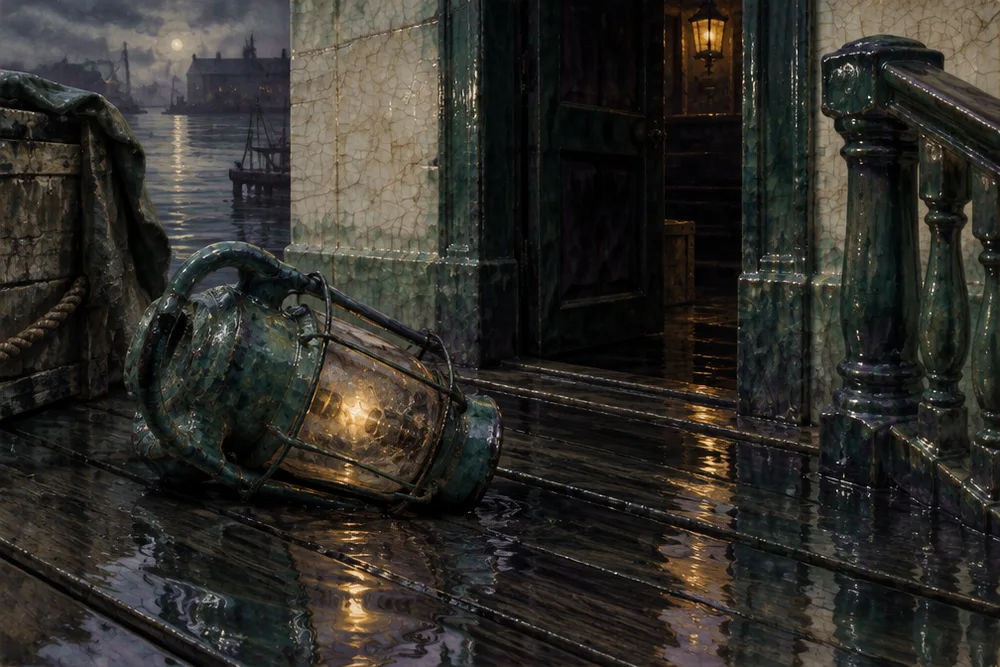
Aster pulled her second foot over the sill. The outer boards took her weight. The door remained open behind her, held by the trunk and the unresolved ownership it represented. She was no longer inside the counterhouse, but she did not yet feel outside it. The cold air tasted of salt and wet timber. Her hands shook from the pressure of the manifest against her ribs.
Iven Pell stood at the edge of the group. His plum cardigan was buttoned wrong at the middle, and his felt slippers had darkened with rain. The silver fringe of his hair clung to his scalp. He looked at Nella, then at the lamp. His left lid drooped as always, but the right eye was bright and sore. He did not reach for her. He only said, “Nella.”
Nella did not answer immediately. She watched the lamp’s small flame through its glass, then met his gaze. The space between them was the width of a yard, twelve winters, and one false signature. “I heard you,” she said.
The door behind Aster pulled inward. The trunk creaked against it, resisting the pressure with a small, steady shudder. On the other side, the counterhouse passage lay in darkness. Aster could still see the threshold, and beyond it the pale line of Nella’s lost doorway, now nearly indistinguishable from the wall. The house had not released its claim. The people had carried theirs into the yard.
Suri read the handover once more, each claimant’s name followed by what remained unresolved. The households answered as they had before, each in their own voice. Nella’s claim was added last, with the room deposit and her chosen agent named. Aster heard herself described as representative, not delivery. The words did not restore her van or repay the work she had lost. They did something more immediate: they placed her on the receiving side of the record.
The lamp’s light wavered. Nella turned its handle in her hand. Aster saw a thin line of black soot on her thumb. “The flame is going,” she said.
No one reached to keep it alive. The lamp had done its work. It had carried the false transfer, marked each name crossed off, and made the locked stair visible long enough for them to act. It had been an object on forms and a light in a room, a piece of evidence and a means of passage. No one needed to own it more than anyone else. Nella set it on the loading boards.