The Widow Window on the Landing
Page 179 of 224
Chapters
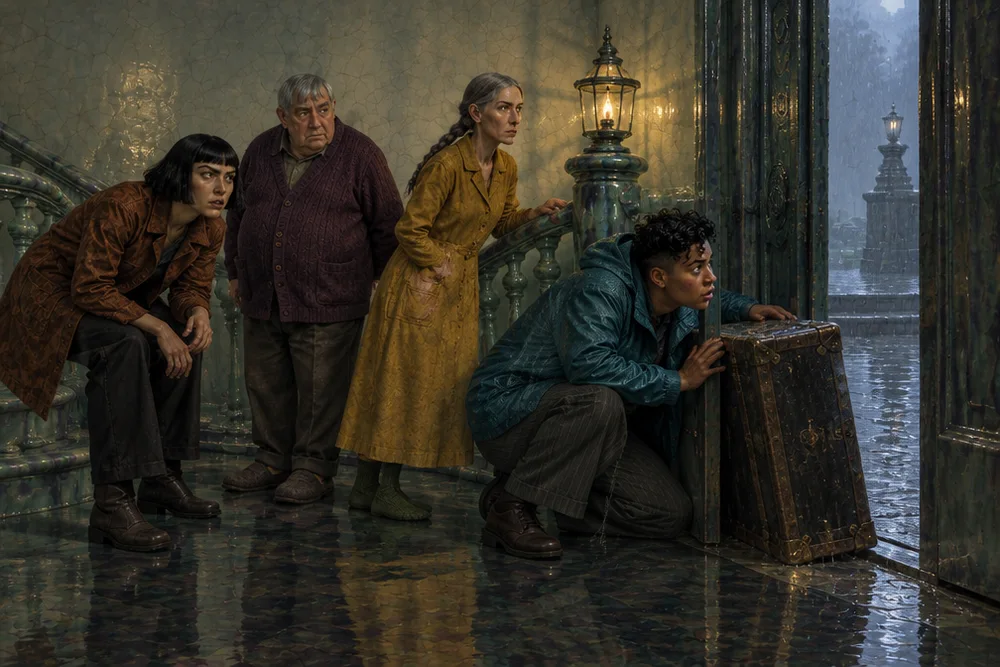
Aster and Iven angled the trunk toward the sill. It was too broad to pass straight. They turned it on one iron corner, slowly, their boots slipping in the glaze pooled over the floorboards. Aster’s square toes planted against the threshold. The lamp warmed her wrists as she lifted its handle with one hand and pointed the light toward the door.
“Not through,” she warned. “Just across.”
They eased the trunk forward until its near end projected into the daylight. The door jerked. Its upper hinge squealed, and the slab began closing with a pressure that made the trunk groan. Iven grunted and shoved back. Aster wedged her shoulder against the opposite corner.
The trunk caught. Its iron corner bit into the jamb, and the door stayed open, a palm’s width wider than before. Beyond it lay the boarding house’s real rear passage and the gray morning outside. Aster could see a strip of Suri’s teal rain shell near the yard gate. Suri crouched there, waiting, one hand raised so Aster could see she was ready to receive the manifest.
Aster kept the lamp steady. “That’s enough. It’s holding.”
Iven let out his breath. “It could hold for an hour.”
“We don’t need an hour.”
They needed every consenting claimant assembled, the correct receipt in Suri’s hands, and an answer to what happened when the passage closed behind them. The trunk could keep a door open, but it could not make the door recognize who was crossing. The distinction had already cost them one attempt and nearly cost Aster herself.
She looked up the staircase. “Bring the first household down.”
Iven began to climb. His slippers made almost no sound. Aster stayed with the trunk and the lamp, watching the door’s thin daylight margin. She thought of the other items that had crossed the threshold without their owners: three households reduced to missing-property forms, a lamp circulated as if it had belonged to no one. The trunk had been used to preserve the evidence. Now it would carry the argument that evidence alone could not make.
The first to descend were the two women from Room Six, one with a wool scarf wound tight around her hair, the other gripping a shallow tin box to her chest. Aster knew their names from the counterhouse ledger, but she did not call them out. They had agreed that their names could be spoken among themselves, not printed for the owner. Instead she asked, “Are you both ready to be received as claimants, with your possessions and years still disputed?”