The Widow Window on the Landing
Page 17 of 224
Chapters
She left the mirror where it stood and returned to the inventory. By midafternoon she had worked through the rooms on the north side and reached the owner’s duplicate sheets. Those were carbon copies of the sheets she was filling in, already marked with names, room numbers, and the broad disposition—collected, retained, or clear. The owner wanted her to reconcile them against the rooms, then send a clean copy downstairs each evening.
The arrangement had bothered her from the start. The owner’s pages were faded and thin, with some entries typed and others written in a round hand that might have belonged to a former clerk. But a duplicate was still a record, and Aster had built her trade on the belief that disagreements between records could be identified before they became expensive. She kept her own notes separate and used the owner’s sheet only as a cross-check.
Room Four belonged to a tenant named C. Orrel. The room was bare except for a brass bed frame, a small drawer unit, and a brown suitcase with a broken handle. The owner’s duplicate said that all effects had been collected. Aster’s room-by-room count did not. She checked the closet, looked beneath the bed, and opened the drawers. They were empty. The suitcase was empty too, though its leather retained a shallow impression where something rectangular had rested.
She wrote “empty case remains” in her notes. Then, on the main inventory, she listed it as an unclaimed item pending decision. The room had been cleared, but the case had not. She would not let a broad description overrule what she could see.
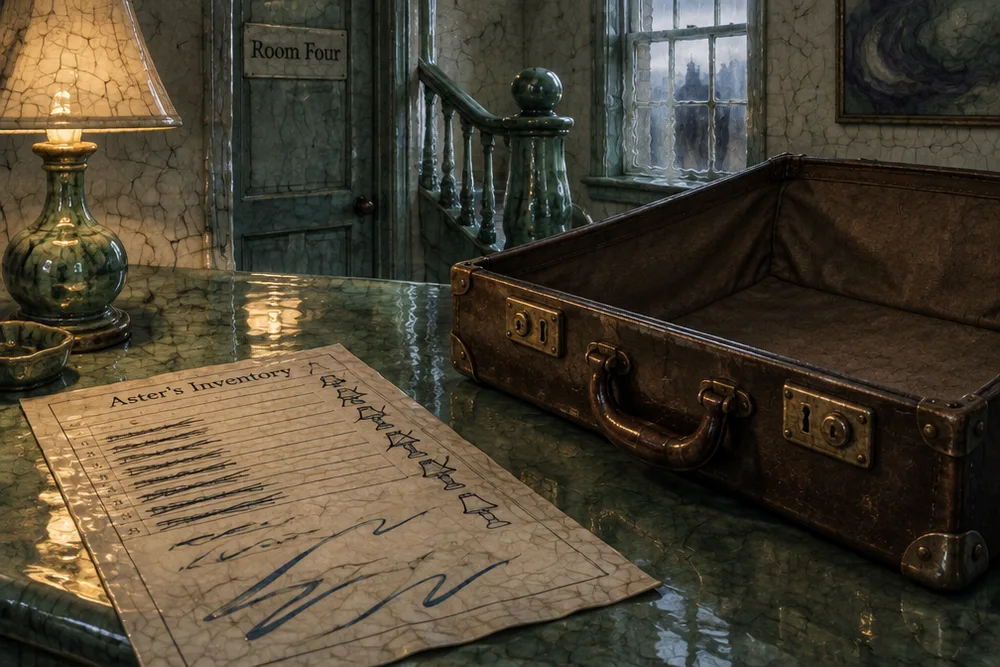
At the foot of the sheet, a small box waited for initials beside the tenant’s name. The owner’s duplicate was already crossed through in pencil: C. Orrel—effects collected. The mark was so light it could have been erased with a sleeve. Aster set her ruler along the line and drew a clean stroke through the name on her working copy. She added her initials and the date. The tenant’s recorded effects had been accounted for, even if one empty suitcase had no clear destination.
It was a reasonable correction. If anything, it made the record more accurate. Aster set the pencil down and turned toward the landing pane, meaning to check the lamp again before she went downstairs for the next stack of forms.
The lamp had gone down one step.
Aster did not move. She looked from the pane to the inventory book, then back to the pane. The amber light sat lower than it had before, close to the turning at the bottom of the visible flight. She counted the steps above it, lips barely moving. There had been six. Now there were seven.