The Widow Window on the Landing
Page 149 of 224
Chapters
They carried the ledger upstairs to the gallery, where Aster had laid out the original room cards in bundles tied with cotton tape. The house was quiet except for rain ticking in the gutter and the thin click of Iven’s slippers on the boards. At the landing, the pane showed the counterhouse stair, its banister glazed as if damp. The lamp waited on the bottom tread.
Aster set the new book on a crate and opened it to the first room. “Room one,” she said. “One iron bed, mattress, blue wool blanket. Tenant departed. No claim outstanding.”
“That room was never occupied,” Iven said.
“The owner lists it as cleared.” Aster turned the page. A column of small room numbers continued down the sheet. 1, 2, 3, 4. Each number stood in a box, as neat as a tally.
Suri laid a carbon copy beside the ledger. “The old register starts at room three. There’s no room one or two. They were storage closets before the conversion.” She pointed to the floor plan on the copy, the faint lines showing the actual rooms. “They’ve counted the front hall and the lodge as occupied rooms.”
“That makes the inventory look complete,” Aster said. “A continuous sequence, no gaps.”
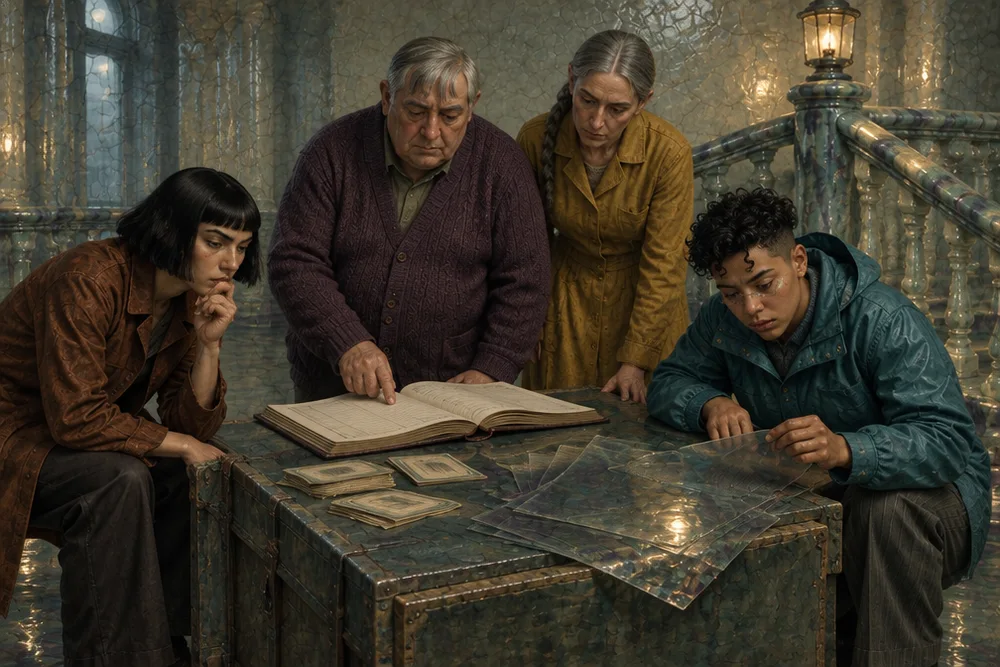
She tracked down the list with her finger. Each time a room number had no matching card, she marked the margin with a small question mark. At room six, the ledger gave the room a single occupant, then declared the contents collected. Aster remembered the room: narrow, with a cracked basin and wallpaper that had bubbled around the stove pipe. The tenant had left a deposit under dispute. There was no collection signature.
“That one’s not cleared,” she said.
Iven looked at the pane. “The owner’s ledger has been prepared from the old one. It may be an error.”
“A convenient error,” said Suri. She lifted another carbon copy, the paper so thin its reverse writing showed through. “The number is here. The name is here. The deposit is here.”
Aster felt the familiar drag of an old business failure, the memory of forms signed too quickly and a client’s accusation afterward. She had learned to trust a signature more than a voice. But the typed declaration did not even pretend to have one. “We don’t correct this in pencil,” she said. “We preserve both versions.”
She copied the disputed number into her working book, adding the source beside it. The new ledger remained open, its neat columns waiting for a signature. Outside the window, the rain blurred the glass; on the other side, the yellow lamp sharpened as if the room had leaned closer.