The Well That Borrowed Thunder
Chapter 2 · The Second Note
Page 3 of 7
Chapters
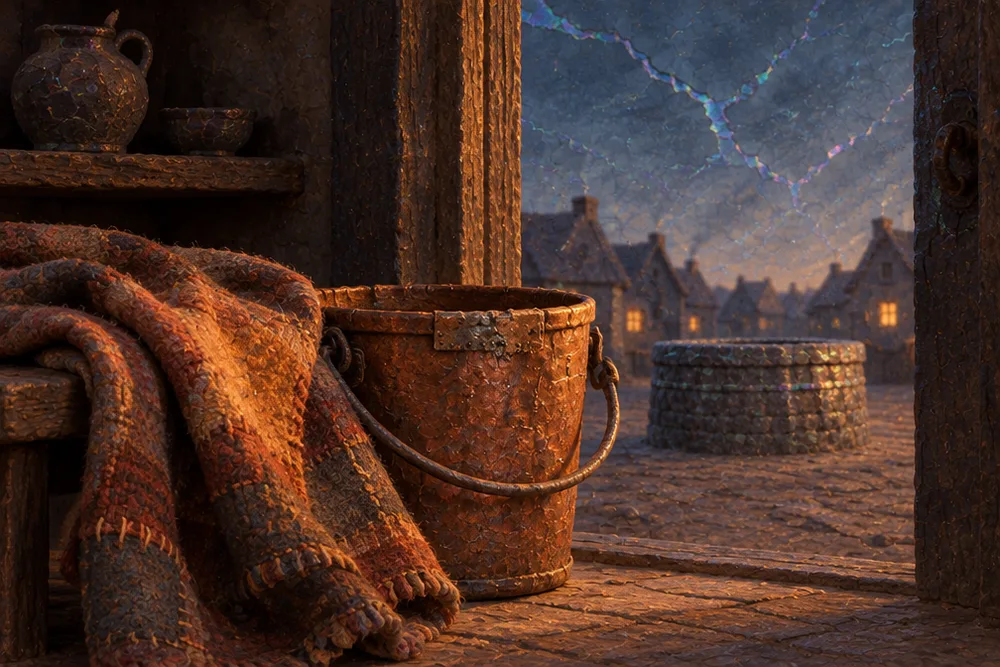
The silver had climbed over the well’s black lip. It made no splash, yet a bright wetness crept down the outer stone, while the paving beneath Yara’s fingertips stayed dry. She wiped her hand on her rust-red vest and hooked the copper bucket at her belt before continuing around the bowl. Behind her, Tovin and Mera remained by the well, their voices lost beneath the trembling of the curb.
At the next doorway, old Pell had gathered his grandchildren under a blanket. He remembered the storm by its flashes, he said: one, two, three, counted on his fingers while his wife rocked their baby. The child slept through every white flare. Pell had thought that was the bargain—light could pass, but noise must stay below. Then his brows drew together. “There was a sound after the last flash,” he said. “A low clang, then a high one. I was going to tell my wife something. I can’t remember what.” His youngest granddaughter stopped rocking the blanket’s fringe.
Two doors farther down, a roof tile lay cracked on the sill, saved from some long-ago storm. The woman who lived there now had heard the story from her father: he had watched the tile break cleanly in two, watched it tumble into the yard, and heard nothing. Not the crack, not the fall. He had laughed, her father said, then fallen silent. When Yara asked what he had been about to say, the woman glanced toward the sleeping room. “He never told us.”
A third house stood warm with banked coals. There, a thin man in a nightcap remembered his grandmother laughing during lightning. He had been small enough to sit beneath her table, holding his hands over his ears, though there had been no thunder to cover. She laughed at something he said, he insisted, not at the storm. She laughed, then went quiet and put a hand on his head. “I’ve never known what I told her,” he said. “Only that I meant to ask her to stay.”
Yara listened at every threshold. Some stories belonged to the speaker; some had been carried down through parents and grandparents, polished smooth by retelling. In one, a storm had lasted all night and the family had slept. In another, a mother had walked barefoot through a flooded yard without hearing the water. Each teller paused somewhere, as if there were a step in the story they could see but could not climb. And in every house, when Yara asked about the first storm they remembered, somebody recalled it: a low clang, then a high one. Afterward, someone had fallen silent.