The Sound of Staying Put
Page 96 of 206
Chapters
Queta’s expression altered, though not into relief. She had been expecting him to insist on the arithmetic without agreeing to its consequence. He wanted to tell her that was not what he was doing. He also knew that he had spent years making the property ledger appear more reasonable by refusing to count his own hours, and that the gesture had never made those hours return to him.
He wrote the turnover duration on the board, using the space beside the slot instead of over the customer’s name. It made the available time look worse. The next appointment could not begin when the machine stopped; it could begin when the floor and machine were ready. A space that had looked like spare capacity became labor on the page.
Queta peeled a corner of the schedule tape from the board and smoothed it back down. “We could stagger the appointments,” she said. “Start the second load when the first is drying.”
“That means someone has to watch both.”
“Someone is already here.”
“Sometimes.”
“We have a shift.”
“The shift sheet says two hours.” Eloy tapped the page. “The business was open almost four.”
“Because the first day ran late.”
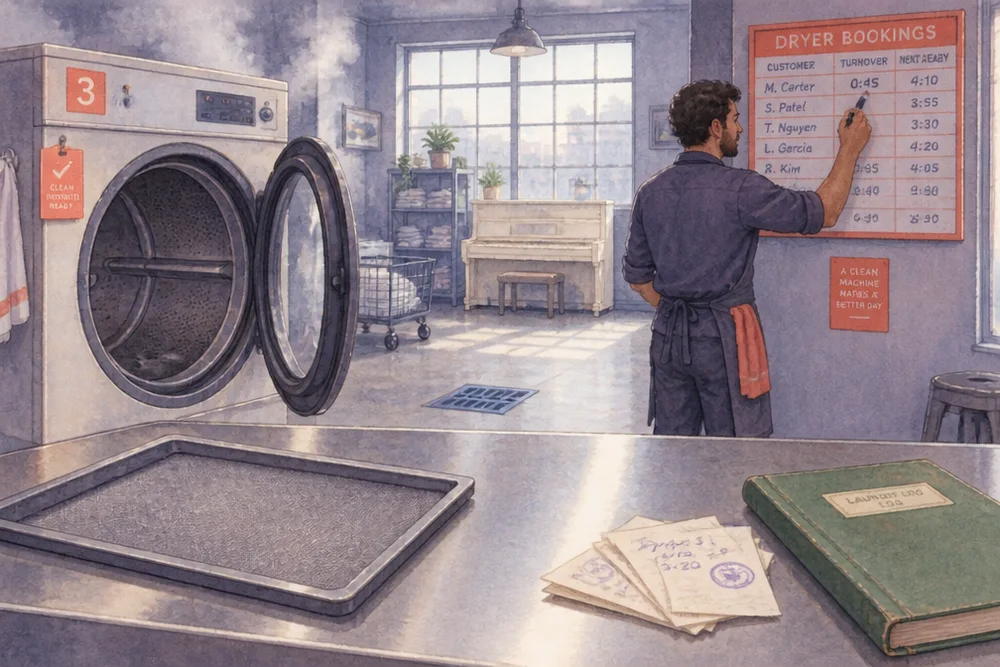
“The second did too.”
She rubbed the tape flat with the heel of her hand. “Then we make the posted hours fit the shift.”
“That means fewer hours.”
“Or a different arrangement.”
“We can test one.” He took out the pencil. “But we should write down the parts we’re removing as well as the parts we’re selling.”
Queta looked at the newly crowded board. “If we leave holes between every load, we’ll have a line of customers and no way to serve them.”
“If we fill every hole, we’ll have a line and nobody paid to serve them.”
They tried the staggered arrangement on paper first. The first large drum began at seven. Once its wash was underway, another customer could be helped at the counter, but not loaded until Queta had checked the first machine and confirmed the second load’s weight. When the first load moved to the dryer, the next washer could start. If the dryer ran long or a customer needed help, the sequence shifted.
Eloy drew boxes on a scrap listing. Each box represented a machine in use; the gaps represented the moments someone had to be present even when a drum stood still. The board reduced the visible queue. It also reduced the number of loads they could accept without overlapping tasks that belonged to one person.