The Sound of Staying Put
Chapter 14 · The Offer with the Empty Room
Page 134 of 206
Chapters
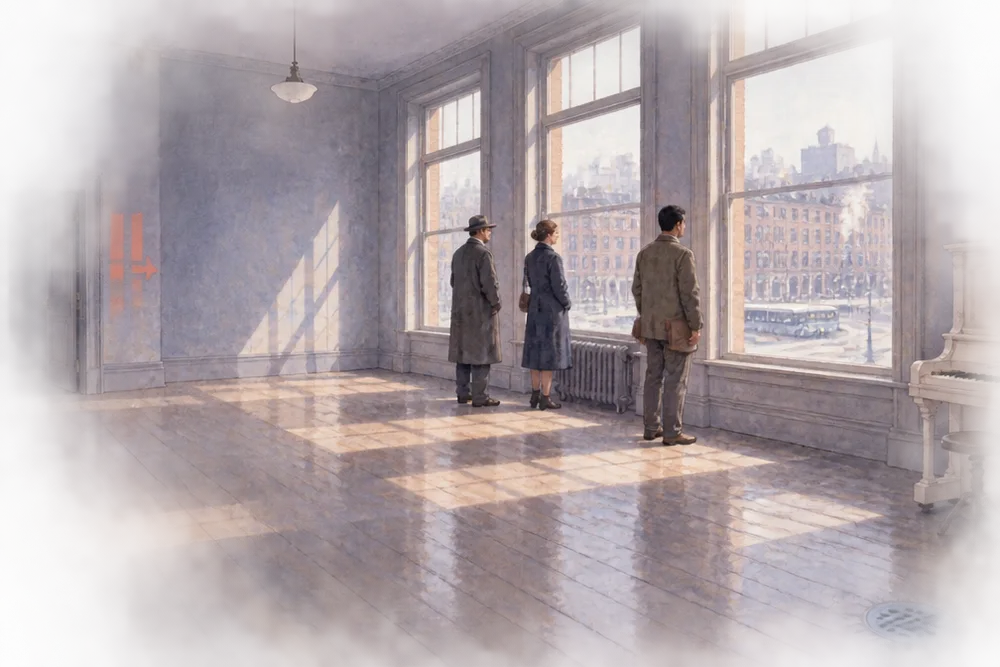
The broker brought the buyer upstairs because the wash floor was still closed and the stairwell had enough room for three people only if nobody stopped. Eloy went last, carrying his receipt wallet flat against his thigh. The buyer, a woman in a dark coat, had already measured the front room from the street. Now she stood by the tall windows, looking past the bus turnaround at the buildings across Bellwether Row.
“The drain is the reason for the reduction,” the broker said. He held a folder open against the piano’s music rest. “Your buyer understands the limitation. The price reflects it.”
Eloy looked at the figure again. It was lower than the first offer and still high enough to make his shoulders loosen before he could stop them. The number would clear the taxes and the remaining bills. It would leave him with money he could use, not another season of invoices he had to explain to himself as temporary.
“And what happens to what’s in here?” he asked.
“Everything removed before closing,” the buyer said. “Piano, machines, whatever remains. I’m buying the property, not the contents.” She said it without looking at the piano. “I’d want the room empty.”
The ivory piano stood against the wall, its chipped bass key pale among the others. Len’s last tuning had left the lid shut and the felt tool roll gone. The room looked larger than it had when Nico’s drum case, music stands, and folding chairs crowded the floor. The vacancy made it easy to imagine a clean sale. It also made Eloy notice the marks where the piano legs had stood for years.
“We can price removal,” the broker said. “It’s routine.”
Eloy’s thumb pressed the wallet’s edge. He had come prepared to hear a price, not to decide what counted as routine. “I want the offer and the removal terms in writing.”
“They’re in the folder.”
He took it from her. The buyer nodded once, as if he had asked for a receipt at a counter, and turned toward the window again.
The broker had brought a measuring tape. It stretched from the door toward the far wall, then lay in a loose curve beside the piano while she marked dimensions on a printed sheet. The buyer walked the room without hurry, stopping where a partition might go, though she did not call it a partition. Eloy remained near the stairs, where he could see both the room and the offer in his hands.
“The separate entrance is useful,” the buyer said. “But I don’t want to inherit a repair project upstairs or downstairs.”