The Sound of Staying Put
Page 31 of 206
Chapters
The water came through in a low, steady rush, then slowed. June crouched closer, heavy lower lids narrowed as she watched the surface. Eloy could hear the bus turnaround over the roof, a groan of brakes followed by doors hissing open. The noise seemed distant beside the wet ticking of his watch.
“That’s bank one,” June said when the last of the measured water had disappeared. “It isn’t fast, but it clears.”
“And bank two?” Queta asked.
“We test it separately. Then we test what happens if the first is still moving when the second starts.” June wiped her hands on a cloth. “Don’t help me by guessing the answer.”
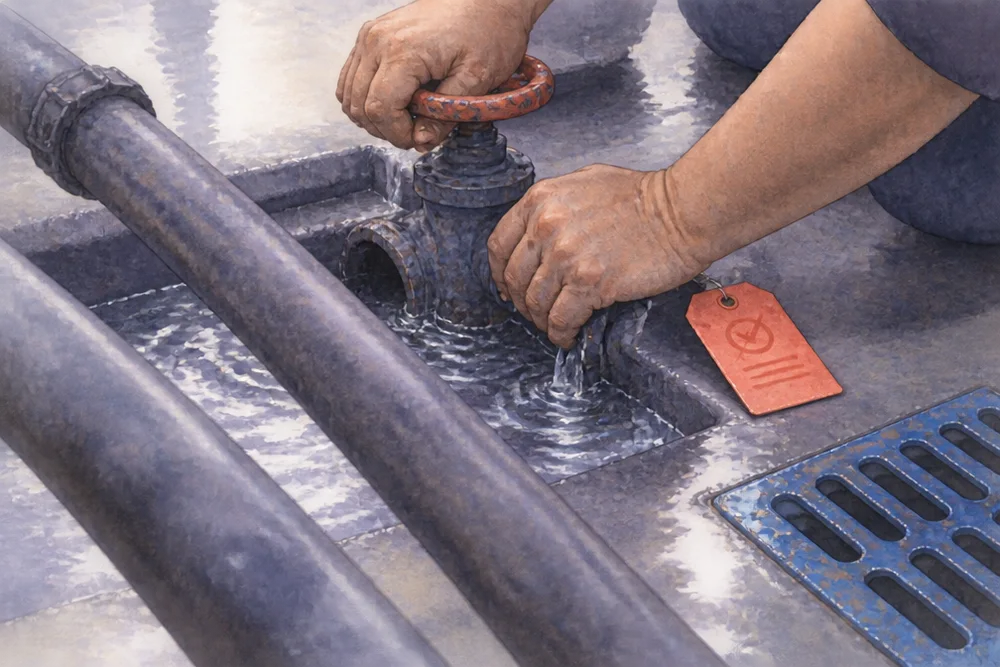
They flushed the second line. It cleared, too, though more slowly. June then set the test to imitate two machines emptying close together. Eloy watched the water rise in the pipe mouth. At first it seemed no different from the single-bank run. Then its surface quivered, climbed, and backed into the trough around the opening.
June shut the valve before it spilled over. The water drained away by degrees, leaving a brown film around the lip.
“One bank at a time,” she said. “The old drain cannot take both banks at once. Not on a real load, and not if you want water staying in the pipe.”
Queta folded her arms. “What would it cost to make it take both?”
“I haven’t opened enough of the line to price that. A costly repair, at minimum. I’m not giving you a number I haven’t earned.”
Eloy looked at the two washer-bank pipes disappearing beneath the building. He had been hoping the limitation would be a switch, a clog, some small obstruction he could buy his way past. Instead it was the building telling them what it could do.
June packed the jug and made a second note on her pad. “If you want an estimate for both banks, I can scope the line. That means opening it. Today’s test tells us the safe limit without that work.”
“One bank,” Eloy repeated. “How many machines?”
“That depends on their discharge and the spacing. We can choose a bank and test the machines in it. You don’t get to call every washer useful just because it’s paid for.”
The words struck harder than they should have. The machines were paid for, or close enough; they had sat behind the shutter through years of bills and arguments. Eloy had counted them as value because he needed some part of the building to be worth what it had cost him. He did not want to admit that a machine which could not safely run might be worth only what someone would pay to haul it away.