The Names Beneath the Plates
Page 202 of 224
Chapters
Bessa Quillbrake was working at the long table by the window, one palm planted beside a length of slate cloth while the other guided a needle through its hem. A pin cushion circled her wrist. She looked up only after Carys had put the last box down. “You came with your things,” Bessa said. “I came to ask about the stockroom.” “You came with your things.” Carys glanced at the stack. “I have two nights.” Bessa pushed the needle through and pulled the thread taut. “I offered you a month if the place is still empty and you can pay your share. I didn’t offer a rescue.” “I’m not asking for one.” “Good. The shelves have to be cleared before you sleep there. The rent is fixed, due each week. You’ll have a corner, not a room with a window. You’ll keep your things on your side and leave the worktable clear.” Bessa held up the cloth, checking the seam. “Can you do that?” “Yes.” “Can you pay?” Carys had counted the money twice in her pocket: her last savings and the small amount still owed from her kitchen shifts. “Not the whole share today. I can pay after kiln work.” “Then find the kiln work first.” Bessa’s voice was flat, but not unkind. She pulled the thread through another stitch. “I’ll hold the place until tomorrow evening. After that, I rent it to somebody who can pay.”
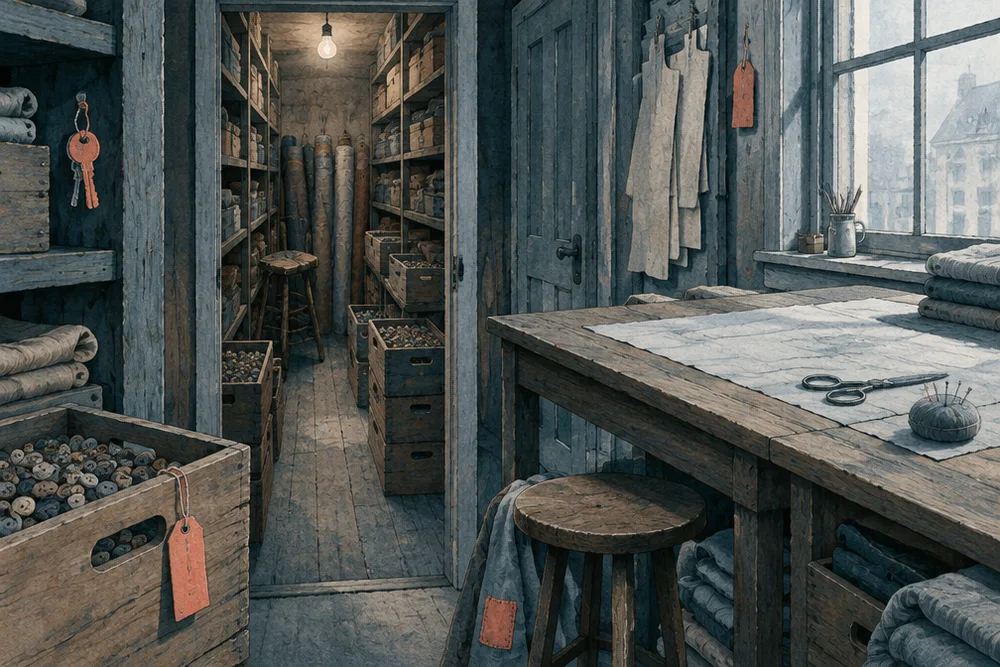
Carys felt her shoulders tighten. “That’s fair.” Bessa finally looked at her. “I don’t need you to call it fair. I need to know whether you can manage it.” “I can.” “Then you can start by clearing the shelves.” She pointed with the needle toward a narrow door behind the cutting table. “There are old pattern rolls, a broken stool and three crates of buttons. The stool’s not mine, so don’t throw it out. The rest can go in labeled bundles on the top shelf. I’ll show you the space after I finish this hem.” Carys picked up the nearest empty crate. She had expected gratitude to make the offer easier to accept, or shame to make it harder. Instead, Bessa gave her a list of work and a price, and the plainness of that steadied her. “I can do the buttons now.” “Sort them by size. Not color. People always sort by color and then can’t find a match.” Carys carried the crate through the narrow door. The stockroom smelled of cloth dust, hot iron and the faint mineral tang of the street’s old drains. A single bare bulb hung from the ceiling. Boxes and shelves crowded the walls, leaving a strip of floor just wide enough for a person to turn sideways. It was not a private room yet. It was space she could earn by making room.