The Names Beneath the Plates
Page 13 of 224
Chapters
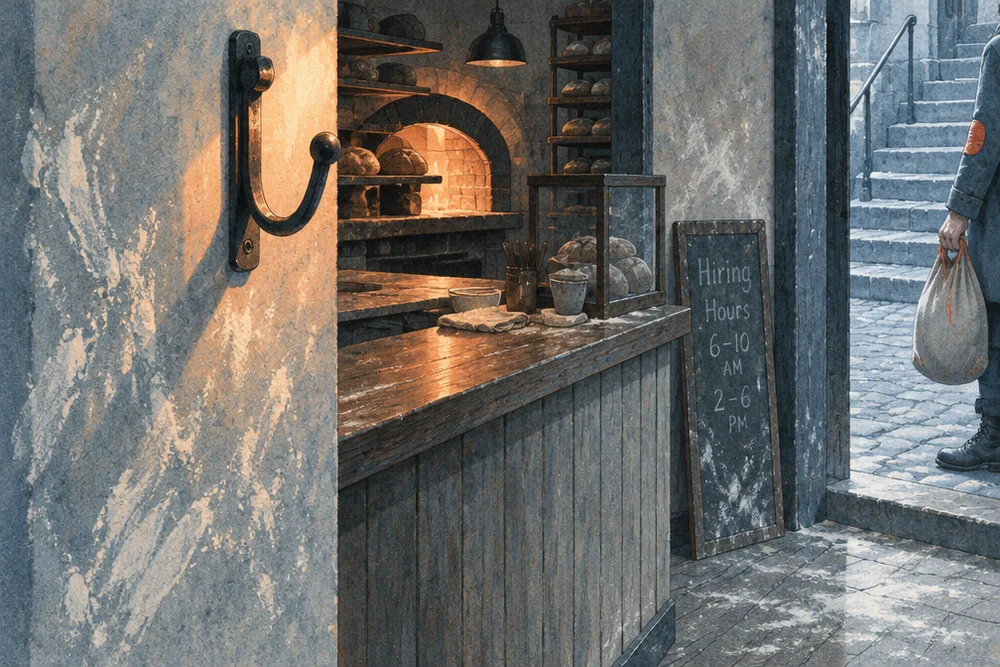
The bakery stood at the turn below Ninth Step, where the stair street widened enough for a handcart to pass. Its ovens breathed warm, yeasty air into the gray morning, and a flour-dusted board leaned by the doorway with the day’s hiring hours chalked across it. Carys stopped on the opposite curb. The sack tugged at her wrist as if it wanted to go inside without her.
A woman in a dark apron came out carrying a bundle. She was broad through the shoulders, with a flour streak on one cheek and a tired crease between her brows. She set the bundle on the low wall, untied it, and drew out a baker’s apron patched at the pocket. Carys saw an empty hook inside the doorway behind her. The apron had been folded as carefully as clean linen, though flour clung to its hem.
A young man waiting by the board glanced at the woman. “That his?” he asked.
“It was,” she said. “I’m clearing it from the hook. They can’t keep making room for somebody who’s gone.”
Carys’s mouth dried. She stepped off the curb. “Are you Orren Pellhatch’s sister?”
The woman looked up sharply. “Who wants to know?”
“Carys. I work at Blue Sluice. I—” She stopped before she could say I found your brother’s name on a plate. That sounded like a trick, or an accusation, or a story told by someone who wanted attention. “I heard his name here.”
The woman’s expression changed, but not toward welcome. She folded the apron over one arm. “People hear all kinds of things.”
“Did he move away?” Carys asked. The words came out too fast. “I mean, did you hear that he moved?”
“That’s what the dormitory office told me.” The woman’s gaze flicked toward the empty hook. “Said he’d packed and gone. No notice, no address. I went there twice. They said his room had been reassigned.” She pressed the folded apron flat against the wall, smoothing a crease that was not there. “I thought he’d decided not to write.”
Carys felt the sack’s cord rub against her wrist. There was something like a gap in the woman’s certainty, but Carys had not earned the right to push a finger into it. “I’m sorry,” she said.
The woman gave a small, guarded shrug. “You didn’t tell me.” She picked up the bundle and turned back toward the bakery. The hook remained visible behind her, bare against the flour-marked wall.