The Names Beneath the Glaze
Page 68 of 230
Chapters
At the rack, Mr. Sallow’s name caught a hard reflection. Ada’s lettering was dimmer, but still there. Iona ran her fingertip along the underside of neither saucer. She had no wish to disturb what had taken hold.
Outside, someone moved through the fog. For a moment she thought it was the same featureless figure. Then she saw a bent head and a hand held close to the body. The shape drifted farther from the school, toward the unseen shore.
Iona turned back to the living and waited for the next memory.
The second success changed the way people approached the table. They stopped asking whether a name could be called and began asking what they had actually seen. A woman remembered a neighbour rolling a sleeve to keep it dry while washing dishes. Two cousins disputed which hand he used, then admitted they had watched him from opposite ends of the same kitchen. Their uncertainty did not make the memory useless; it made them look again.
Iona did not call every name offered. She listened, asked where the detail came from, and marked the answers. When someone repeated a story, she asked who had told it. When two witnesses agreed on an object but not a person, she left the saucer alone. The method was neither quick nor safe, but it kept them from turning the dead into a procession of guesses.
The hall’s lower windows clouded from the outside. Beyond them, shapes drew away from the glass and gathered along the submerged road. Their silhouettes were faint and anonymous, stretched by the water and the carbon-gray fog. None had come through the doors. None had spoken. Iona felt the pressure of their attention anyway.
“Can they hear us?” a little girl asked.
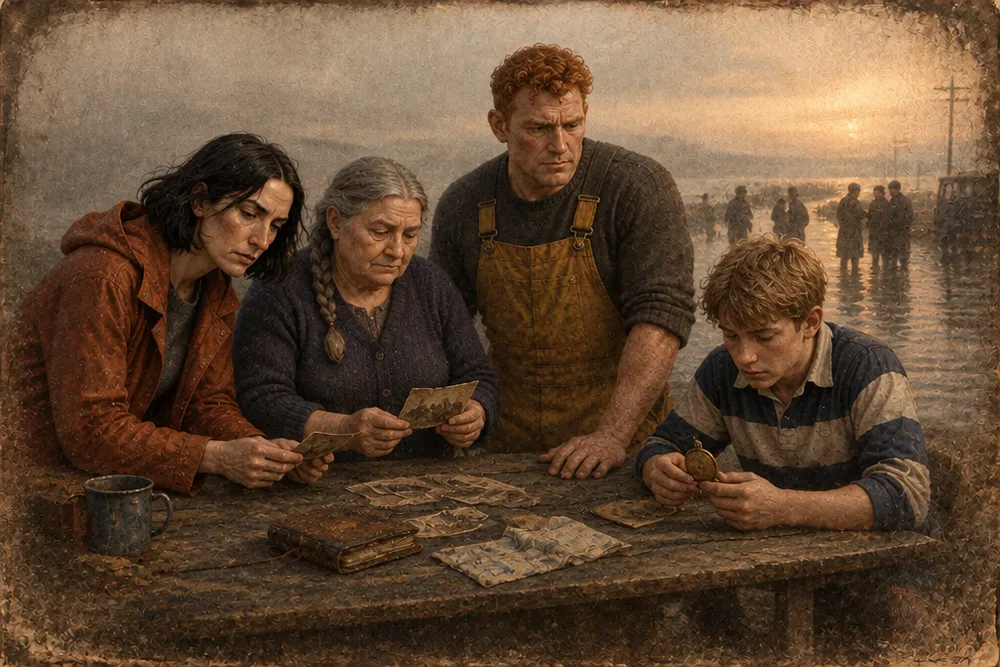
“Maybe,” Iona said. “But we’re speaking to the person we remember, not to the whole crowd.”
The girl nodded. Her grandmother held her hand. Together they described a woman who had always saved the crust from a loaf for the ducks. The girl had seen the crust in a coat pocket; her grandmother had seen the woman kneel by the water and break it into pieces. Iona wrote down both memories, then checked their name against the list.
“Is that enough?” the grandmother asked.
“It’s enough to try.”
The girl gave the name. Her grandmother added the bread and the ducks. The saucer remained blank.
The girl’s chin trembled, but she did not cry. “Maybe I got the coat wrong.”
“Maybe,” said Iona. “Or maybe she isn’t one of the ones waiting here. We don’t know.”