The Names Beneath the Glaze
Chapter 6 · Three Short Notes
Page 59 of 230
Chapters
The school hall smelled of wet wool, chalk dust, and the orange cordial someone had poured into a bucket for the children. Iona stood beside the raised stage with the saucer rack cradled against her ribs. A line of islanders had formed between the trestle tables, each holding a memory as cautiously as a dish that might break. Outside, water slapped the lower windows though the tide had not moved since dawn.
“We remember him as Ellis,” said a woman in a red scarf. “Ellis Bell. He had a boat hook, always. Used to tap the stones with it.”
“That was his father,” said the man behind her. His hands were folded over a walking stick. “Ellis was a schoolboy when he went over. He had one good shoe and one with a split sole.”
“He had a dog,” someone said from the back.
Iona looked down at the names pencilled on the paper strips tucked beneath the rack’s empty saucers. Ellis Bell. No glaze. The name meant nothing to her beyond its shape. “Did any of you know him personally?”
The woman in the scarf lifted her chin. “My mother did. She said he was tall.”
“Your mother said he was short,” the man with the stick replied. “She could never see over the counter.”
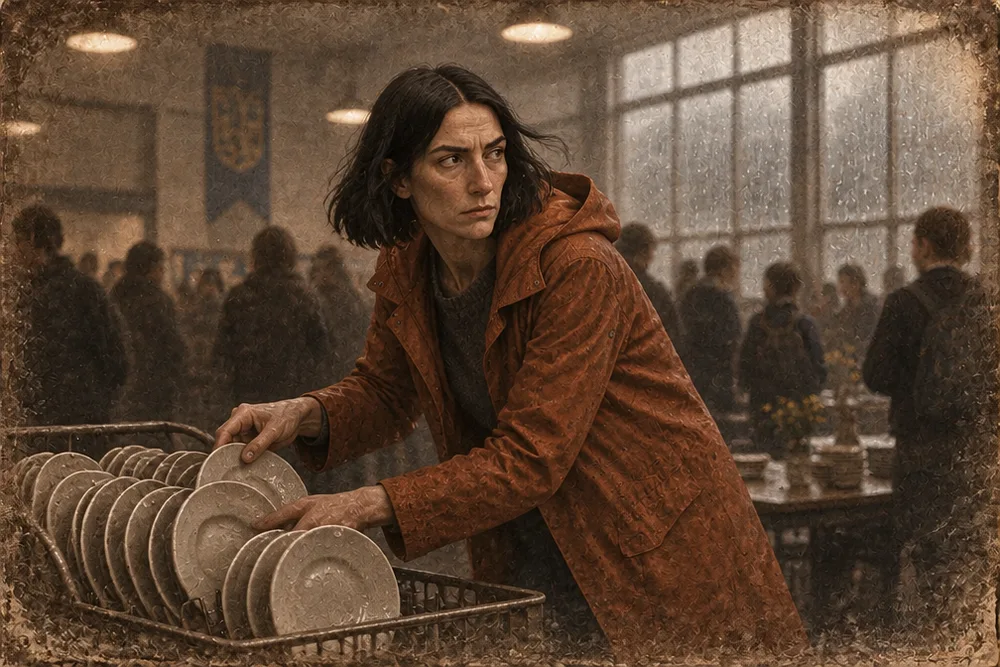
A murmur gathered, not quite an argument, but close enough to make the hall feel smaller. Iona could hear the dead at the windows: a soft, patient shifting, like people waiting for a bus in rain. They did not knock. They watched the living make a mess of the past.
“Stop,” Iona said. Not loudly. The word nonetheless cut through the room. “A name isn’t enough.”
She had thought the name itself would be a key. At the office, the recording had spoken them all cleanly, each syllable correct; still the saucers had gone blank. Here the people who remembered offered a dozen keys and none fitted. She needed something specific. A thing a person had done, worn, kept, or left behind. Something that belonged to the dead and could be carried in a living mouth.
“Let’s take one person,” she said. “Not the whole list. Someone you knew.”
The red-scarfed woman looked down at her hands. “Ada Morrow. My aunt. She was my mother’s sister. I was too young to remember much.”
“Then don’t borrow what your mother said,” Iona replied. “Tell me what you remember yourself.”
The woman’s face tightened, and Iona felt the impatience in the room turn toward her. She understood it. People had been asked to repeat names all morning, to stand aside from the windows, to leave their kitchens and walk uphill. A dead stranger pressed at every pane. Their own memories were not a public storehouse for her to rummage through.