The Loaf That Carried the Tide
Page 3 of 6
The ropekeeper answered first. He rubbed one long thumb along the rope coil on his shoulder. “The ferry,” he said. “The council told me to cast it off. I remember the line burning my palm. Several households were aboard.” He looked toward the harbor mouth, where the shut gate cut across the pale morning. “They said the crossing would be temporary.”
The netmender had come back inside. She stayed low on her heels, hands on her knees. “I saw the ferry try to turn,” she said. “I pulled the gate shut before it could. There wasn’t room for it to come back through.” Her face was still and careful. “The council said we were short of flour. They said we had to keep what we had.”
The ferryman’s bent knee straightened. Then he set his weight down again, not quite steady. “My sister was aboard,” he said. “She had a bread basket with her.” His eyes went to the third slice, to the crescent curling through its crumb. “I helped pull up the landing afterward. We broke it apart and took the boards. I told myself it was only lumber.”
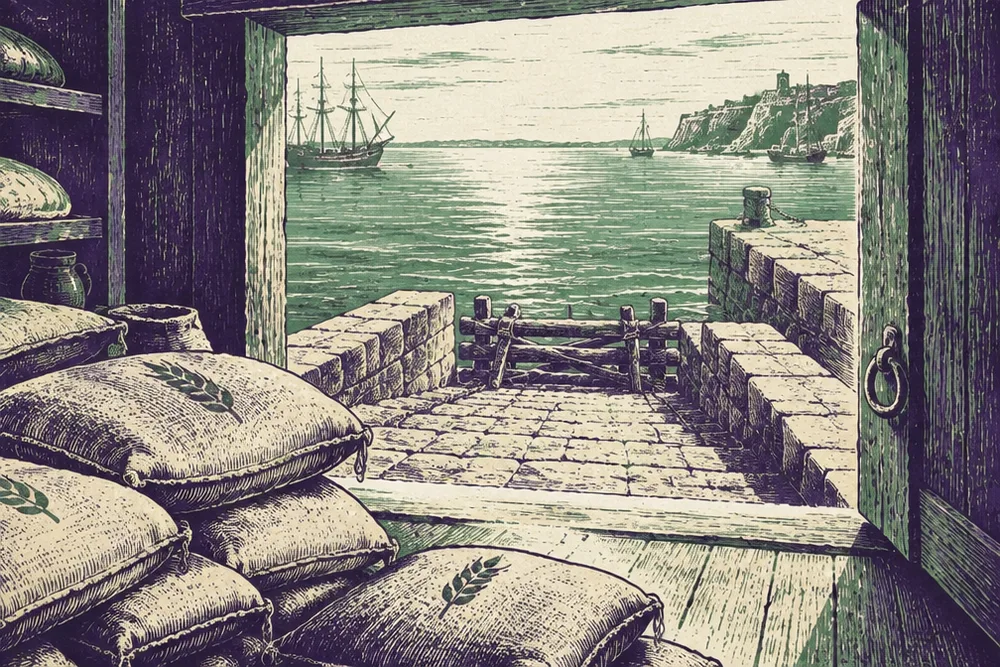
Sola had known the story in pieces, as everyone did. Twelve years ago: a flour shortage, a ferry sent away, a gate closed. The village had spoken of necessity, then spoken of other things. She had never asked where the old passenger landing went. Now she followed the ferryman’s gaze from the hatch, set directly over the lower slip, to the heavy sacks stacked across the upper ramp.
The bakehouse stored its communal winter flour there. Beneath the sacks and planks, the landing stones ran down toward the water. The hatch had once opened over a place where a boat could come alongside. Sola saw the pale edges of the stored boards and understood how neatly the village had made a wall out of a welcome.
Beyond the gate, the opposite shore lay under a thin wash of morning light. The gate remained barred and the harbor empty, while the loaf held incoming water in three cut pieces. Its tide continued toward the crust, indifferent to the old words used to justify the shut gate. A woman on the quay shouted as another boat settled hard against the stones. The villagers turned toward Sola. She made no promise to solve it before supper. She looked at the oven’s narrow doorway, then the slices, and kept her hands off them.
The ropekeeper’s coil creaked as he shifted. The netmender watched the bread. The ferryman stood with his eyes on the hatch and the flour above the buried slip. Sola laid the knife beside the loaf. Before she could send the tide anywhere, she would have to make room for what the village had sent away.