The Last Stop on the Way Back
Chapter 12 · The Borrowed Hall
Page 109 of 316
Chapters
The depot waiting room had been built for people who knew when they were leaving. Its benches faced the fare windows; its clock had a minute hand broad as a knife. Now the clock was stopped at 8:17, and blankets covered the benches. People slept beneath the timetable for a tram that no longer ran. Their shoes, stiff with salt, stood in neat pairs along the wall as if they expected inspection.
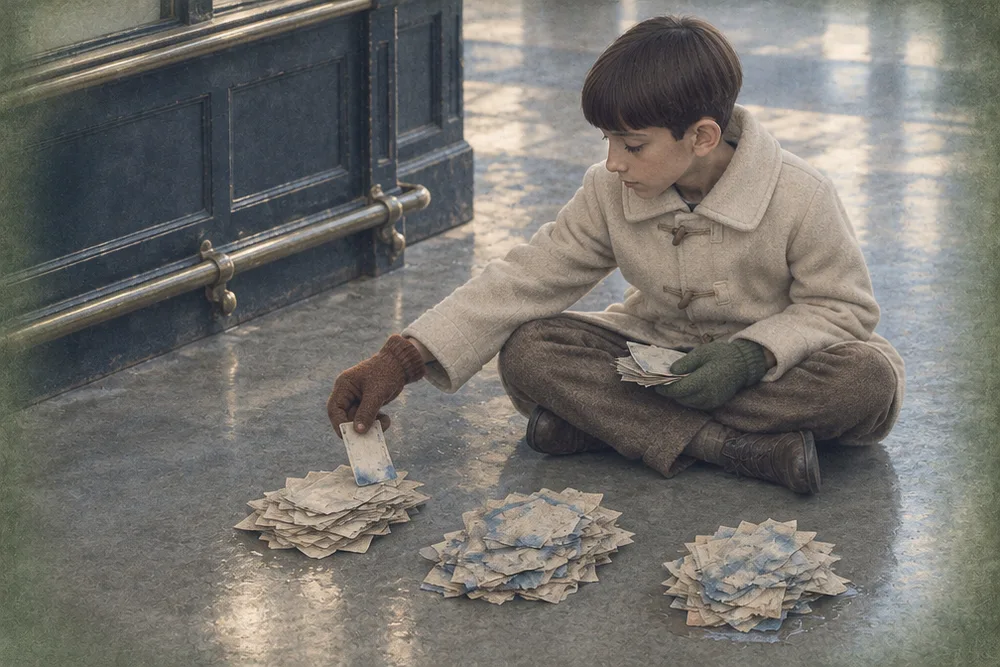
Vero sat cross-legged on the floor with a stack of papers balanced on his knees. The papers were not tickets, though they had once been tickets. Names and addresses had been written on them in three kinds of ink, some blurred by damp. He had been asked to help because he could read the old writing and because, unlike the adults, he could fit beneath the long counter to retrieve anything dropped behind it.
“If you find a name, don’t decide where it goes,” Serrat had told him. She was moving between the sleepers with a pot of hot water, her copper coils tucked into their net. “Just sort the names. Let people tell us what they need.”
So Vero made three piles: names he could read, names he could partly read, and names that had run into blue smudges. The first pile grew. He copied each one into a new ledger, using the stub of a pencil tied to the counter with string. Beside each name he left a blank space for a place to sleep.
A woman with a white scarf leaned over his shoulder. “That one’s mine,” she said, pointing at a name in his first pile. Her finger shook. “But don’t put my sister with the people from South Cut. She’s not there.”
Vero erased the space beside the name, though it was already blank. “Where is she?”
“I don’t know.”
He looked at the woman’s face, waiting for her to add something. She did not. Vero set the paper aside, not with the unreadable ones but by itself, where nobody could mistake it for a settled answer.
The waiting room smelled of boiled water, wet wool, and the iron dust that came from the tram rails. Outside the windows the harbor lifts clanked on their chains. Each time they moved, a small shiver passed through the depot floor.
By noon, the names had become a map of things that were gone. Whole streets had been renumbered. A bakery was now a fish office; a lane that had once ended at the water had been filled with warehouses. Some addresses still existed, but the families who had lived there had grown old or moved away or died. Vero knew the words for those things. He did not yet know how to put them beside a person’s name.