The Last Minute in the Vending Machine
Page 35 of 196
Chapters
She called the concession office listed on a faded service sticker inside the machine’s side panel. The number rang through to an answering service that routed her to a retired vending contractor. He remembered the machine’s model but not its stock. Its internal access had been sealed years ago, then opened during renovations. The board’s maintenance log noted the seal replacement but gave no name for the person who had requested it.
Miren asked whether a watchmaker had been paid to service a dozen watches in the past six months. The contractor had no records that old. He suggested the union archive, where receipts from station concessions sometimes appeared in grievance packets. Before she could ask what he meant, he disconnected to take another call.
The union archive occupied the old pay office at street level, a narrow room with a counter scarred by decades of coin trays. Miren was not allowed to handle the boxes without a steward present. She left a request describing the machine, the watchmaker’s possible invoice, and the serial tab she had found. She did not include the passenger’s name.
On the way out, she passed a framed station photograph pinned beside the archive door. It showed Glasshook’s lower island before the derailment, the dispatch window open, workers gathered around a trolley. A woman in a reflective vest stood with her feet wide apart, dark hair in a coiled bob. The photograph’s coarse grain softened her features but did not obscure the stance. The caption named her Nella Dain.
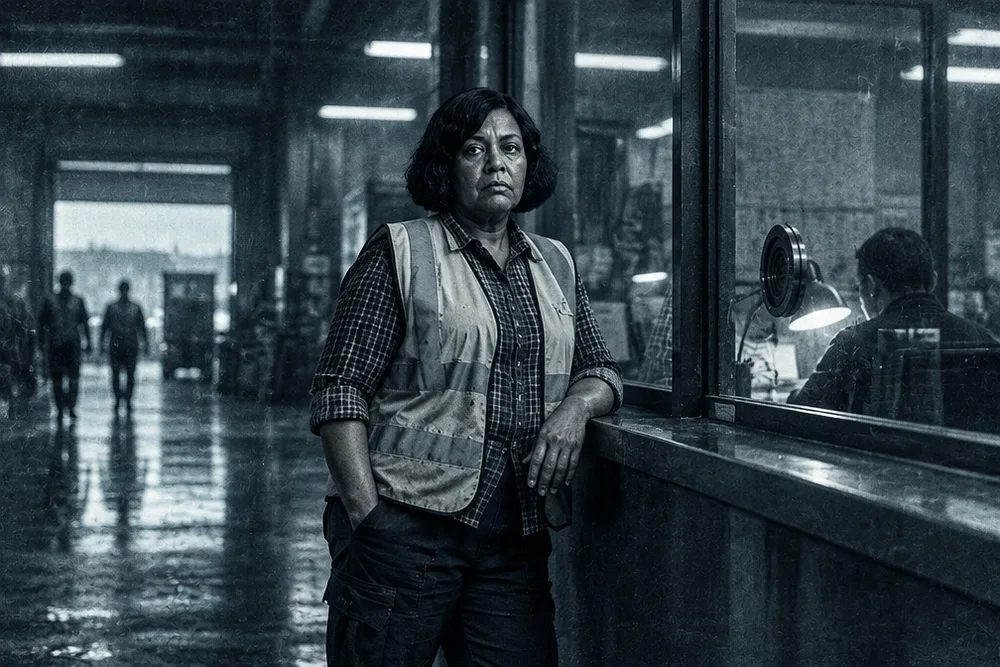
Miren had seen Nella’s name in the official chronology. The report said she had delivered her warning after the train had already departed. Miren looked again at the closed dispatch window in the photograph and remembered the machine on the opposite wall. In the old picture, a clock hung above the window, its face turned toward the platform, while a second small clock was just visible inside the dispatch room.
She returned to the workshop and searched the board’s public records for the machine’s service history. One document listed its dimensions, its electrical inspection, and a concession access panel. Another identified the panel’s key type but no keyholder. The vending machine had not been part of the station’s passenger inventory when Glasshook closed, yet it had remained in place through the sealing of the lower platform.
The watches made a faint, steady ticking when she stood close enough to hear them. It was a reassuring sound, too ordinary for the oddity they carried. She set her own calibrated timer beside the case and watched the second hand advance. The watch continued to keep time. Its missing minute was not being recreated now; it had happened before, and the pause was fixed into its present offset.