The Last Minute in the Vending Machine
Chapter 18 · Paid Overlap
Page 185 of 196
Chapters
Eight months after the hearing, Miren Vossick stood behind the yellow line at Glasshook and watched a train wait. The lower island remained closed to passengers, its tiled spine damp with seepage, its vending machine dark beneath a sheet of clear security plastic. Above, through the glazed stair, morning riders moved in a steady blur. The working interchange had learned to look past the sealed level. Today, a new sign made that harder: CREW HANDOFF IN PROGRESS. DEPARTURE WILL FOLLOW ACKNOWLEDGMENT. The public board showed a delay of one minute and seventeen seconds.
Miren had been asked to witness the first handoff under the binding rule. She had not been asked to repair anything. Her charcoal coat hung open over a dark shirt; the canvas tool roll at her hip was lighter than it had been in years. On the mezzanine, a clock ticked behind wired glass in her shop. Here, a clock had been installed beside the crew display, the two faces synchronized but separately labeled: PUBLIC TIME and CREW TIME. Their second hands crossed at the same instant. The difference was no longer hidden in a conversion sheet.
Two workers stood in the lit service alcove by the platform edge. One held the shift log against a clipboard; the other, a woman with a white safety helmet under her arm, checked a radio and looked toward the train. The departing operator remained in the cab. Nobody was rushing the exchange. A supervisor watched from behind a striped floor mark, not pushing, not pretending the pause was an accident.
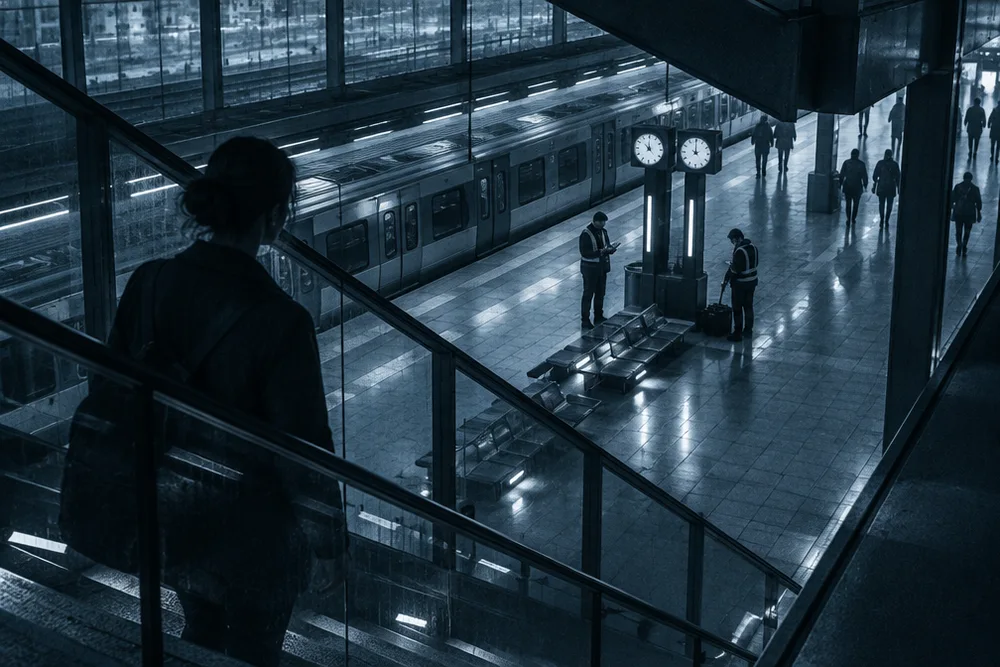
Miren leaned from the hips, her familiar stance, and read the rule printed below the displays. Paid overlap begins before the outgoing worker's authority ends. No movement until the incoming worker acknowledges the handoff. The sentence was plain enough to fit on a notice. It had taken a public hearing, three versions of the record, a labor compromise, an admission, and a dead woman's recorded voice to make it possible.
The incoming worker read the log aloud. The outgoing worker answered with the track condition and the status of the signal relay. A pause followed. On the board, the delay climbed to one minute and twenty seconds. A few commuters glanced up through the stair glass. Then the incoming worker repeated the relay status, named the responsibility she was accepting, and signed the box. The outgoing worker acknowledged her signature. Only then did the supervisor raise one hand to the operator.