The Last Minute in the Vending Machine
Page 20 of 196
Chapters
By noon the workshop’s public clock advanced another minute, its white numerals changing without a sound. Miren kept reading the papers. She was no longer asking where each witness had been when a watch paused. She was asking which clock, call, or reflected face had placed them there.
The first statement belonged to a woman named Hara, who had been waiting beside the east kiosk. Miren found the clock reference on the second page, a line missing from the index summary: “The board over the kiosk changed while the vendor was handing me my cup.” Hara had not claimed to know the exact minute. She had noticed the change because the vendor’s paper sleeve was damp and the black digits blurred when she looked up.
Miren marked the line with a narrow strip of paper. She did not assume that Hara had been right about the clock. She wrote “kiosk board—observed change” in the new column. The second affidavit described a telephone call. Its writer remembered the public announcement interrupting a recorded message, then recalled the call’s time from the phone bill. A timepiece again, though no watch or wall clock appeared in the sentence.
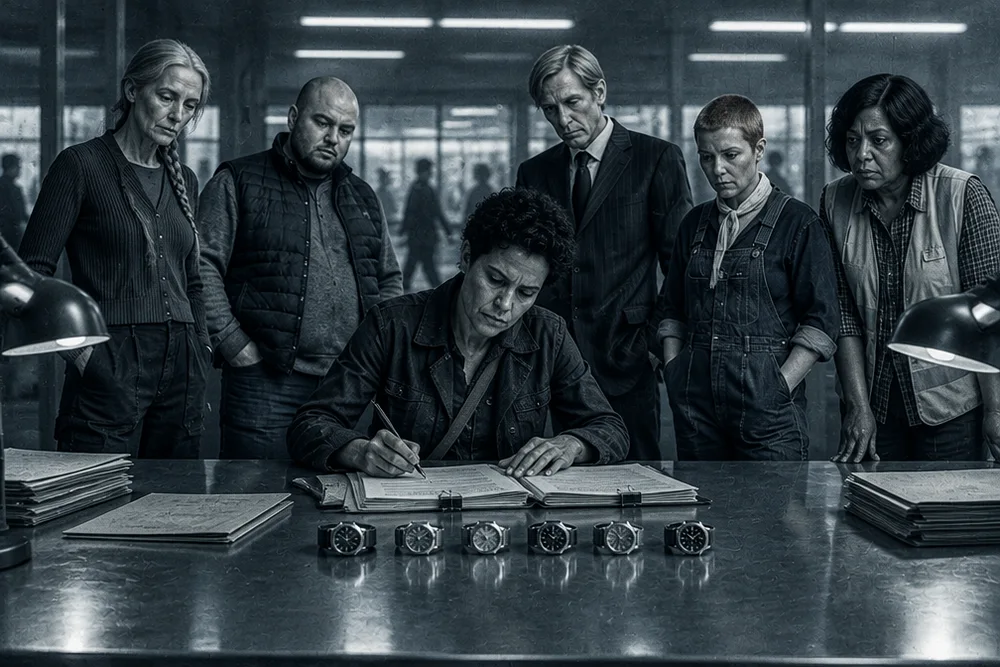
On the third sheet, a man said he had checked the clock over the ticket barriers because the train he expected was late. The fourth witness had followed the second hand on her own wristwatch while waiting for her partner to return from the washroom. The fifth had heard an attendant announce that the next service was “at the top of the minute.” Different forms of evidence; all of them ways to locate a moment.
Miren set down her pencil. The affidavit stack had appeared to scatter the passengers across separate places and minutes, as if the range of their accounts made them useful only for excluding one another. But every account had been tethered, loosely or tightly, to a measure. The statements did not all rely on the same clock. They did not even agree that they had seen the same kind of clock. That did not make them worthless. It made the differences important.
She checked the watch photographs. The first watch had stopped at 8:14. The second at 8:42. The third at 9:03. Those were dial readings, not necessarily times at Glasshook, and she had been careful to say so in her notes. Each watch had been running with a different offset before its latch caught. Their identical sixty-second holds could not establish when any witness had been at a given place. They could, however, make a person look at a minute as a thing with an edge.